Globalisation is often assailed as increasing inequality across the board. But an interesting study in Mumbai, which deserves to be replicated in other Indian cities, suggests it can decrease gender inequalities and reduce the relevance of caste, a prime factor behind inequality in India. The study, based on a large sample and published in the American Economic Review, showed that access to English education increased the range of choices available to boys and girls coming from urban working-class homes where caste identities are still strong. Those going to Marathi schools are likely to remain stuck in blue-collar occupations when they pass out, but those going to English schools often graduate to white-collar professions. And that may work in favour of girls. Boys are part of a network that funnels them from Marathi schools to traditional jobs in mills, factories, dockyards or construction. But girls, not being part of this network, can go to English schools and move on to white-collar jobs. Being part of the new economy also opens up choice in marriages. It was found that 31.6 per cent of those who went to English schools had inter-caste marriages, as opposed to only 9.7 per cent of those who studied in the Marathi medium. Caste distinctions will soon blur if a large number of young people marry outside caste. The practical conclusion from such a study looks simple. If you're a Dalit or a woman and want to liberate yourself from social constraints, learning English would be a giant first step. It's interesting to compare this with the method for encouraging social mobility favoured by politicians: greater reservations for OBCs, a loose category within which all sorts of politically favoured constituents are included. The problem with that is it's a bit of a zero-sum game. To reserve a seat for someone belonging to a quota is to deny it to another, perhaps equally deserving candidate. It also undermines the principle of merit in educational institutions and jobs. But to learn English is not a zero- or even a negative-sum game. Anybody can learn, and demand will follow supply. Moreover, it allows one to access opportunities in the local as well as global economy. When the Indian economy suffers from a skills shortage, there can't be anything wrong with this. It's been found that higher numbers of those educated in English migrate from their state. That not only weakens caste ties, but labour flows can follow the jobs, which is good for the economy. If it's serious about encouraging social mobility, the government should promote the use of English.
Sunday, November 25, 2007


Friday, November 23, 2007
The capacity of empathy is multilayered. We share a core with lots of animals
The Moral Ape
The deepest foundation on which morality is built is the phenomenon of empathy, the understanding that what hurts me would feel the same way to you. And human ego notwithstanding, it's a quality other species share.
It's not surprising that animals far less complex than we are would display a trait that's as generous of spirit as empathy, particularly if you decide there's no spirit involved in it at all. Behaviorists often reduce what we call empathy to a mercantile business known as reciprocal altruism. A favor done today—food offered, shelter given—brings a return favor tomorrow. If a colony of animals practices that give-and-take well, the group thrives.
But even in animals, there's something richer going on. One of the first and most poignant observations of empathy in nonhumans was made by Russian primatologist Nadia Kohts, who studied nonhuman cognition in the first half of the 20th century and raised a young chimpanzee in her home. When the chimp would make his way to the roof of the house, ordinary strategies for bringing him down—calling, scolding, offers of food—would rarely work. But if Kohts sat down and pretended to cry, the chimp would go to her immediately. "He runs around me as if looking for the offender," she wrote. "He tenderly takes my chin in his palm ... as if trying to understand what is happening."
You hardly have to go back to the early part of the past century to find such accounts. Even cynics went soft at the story of Binta Jua, the gorilla who in 1996 rescued a 3-year-old boy who had tumbled into her zoo enclosure, rocking him gently in her arms and carrying him to a door where trainers could enter and collect him. "The capacity of empathy is multilayered," says primatologist Frans de Waal of Emory University, author of Our Inner Ape. "We share a core with lots of animals."
While it's impossible to directly measure empathy in animals, in humans it's another matter. Hauser cites a study in which spouses or unmarried couples underwent functional magnetic resonance imaging (fMRI) as they were subjected to mild pain. They were warned before each time the painful stimulus was administered, and their brains lit up in a characteristic way signaling mild dread. They were then told that they were not going to feel the discomfort but that their partner was. Even when they couldn't see their partner, the brains of the subjects lit up precisely as if they were about to experience the pain themselves. "This is very much an 'I feel your pain' experience," says Hauser.
The brain works harder when the threat gets more complicated. A favorite scenario that morality researchers study is the trolley dilemma. You're standing near a track as an out-of-control train hurtles toward five unsuspecting people. There's a switch nearby that would let you divert the train onto a siding. Would you do it? Of course. You save five lives at no cost. Suppose a single unsuspecting man was on the siding? Now the mortality score is 5 to 1. Could you kill him to save the others? What if the innocent man was on a bridge over the trolley and you had to push him onto the track to stop the train?
Pose these dilemmas to people while they're in an fMRI, and the brain scans get messy. Using a switch to divert the train toward one person instead of five increases activity in the dorsolateral prefrontal cortex—the place where cool, utilitarian choices are made. Complicate things with the idea of pushing the innocent victim, and the medial frontal cortex—an area associated with emotion—lights up. As these two regions do battle, we may make irrational decisions.
It's not surprising that animals far less complex than we are would display a trait that's as generous of spirit as empathy, particularly if you decide there's no spirit involved in it at all. Behaviorists often reduce what we call empathy to a mercantile business known as reciprocal altruism. A favor done today—food offered, shelter given—brings a return favor tomorrow. If a colony of animals practices that give-and-take well, the group thrives.
But even in animals, there's something richer going on. One of the first and most poignant observations of empathy in nonhumans was made by Russian primatologist Nadia Kohts, who studied nonhuman cognition in the first half of the 20th century and raised a young chimpanzee in her home. When the chimp would make his way to the roof of the house, ordinary strategies for bringing him down—calling, scolding, offers of food—would rarely work. But if Kohts sat down and pretended to cry, the chimp would go to her immediately. "He runs around me as if looking for the offender," she wrote. "He tenderly takes my chin in his palm ... as if trying to understand what is happening."
You hardly have to go back to the early part of the past century to find such accounts. Even cynics went soft at the story of Binta Jua, the gorilla who in 1996 rescued a 3-year-old boy who had tumbled into her zoo enclosure, rocking him gently in her arms and carrying him to a door where trainers could enter and collect him. "The capacity of empathy is multilayered," says primatologist Frans de Waal of Emory University, author of Our Inner Ape. "We share a core with lots of animals."
While it's impossible to directly measure empathy in animals, in humans it's another matter. Hauser cites a study in which spouses or unmarried couples underwent functional magnetic resonance imaging (fMRI) as they were subjected to mild pain. They were warned before each time the painful stimulus was administered, and their brains lit up in a characteristic way signaling mild dread. They were then told that they were not going to feel the discomfort but that their partner was. Even when they couldn't see their partner, the brains of the subjects lit up precisely as if they were about to experience the pain themselves. "This is very much an 'I feel your pain' experience," says Hauser.
The brain works harder when the threat gets more complicated. A favorite scenario that morality researchers study is the trolley dilemma. You're standing near a track as an out-of-control train hurtles toward five unsuspecting people. There's a switch nearby that would let you divert the train onto a siding. Would you do it? Of course. You save five lives at no cost. Suppose a single unsuspecting man was on the siding? Now the mortality score is 5 to 1. Could you kill him to save the others? What if the innocent man was on a bridge over the trolley and you had to push him onto the track to stop the train?
Pose these dilemmas to people while they're in an fMRI, and the brain scans get messy. Using a switch to divert the train toward one person instead of five increases activity in the dorsolateral prefrontal cortex—the place where cool, utilitarian choices are made. Complicate things with the idea of pushing the innocent victim, and the medial frontal cortex—an area associated with emotion—lights up. As these two regions do battle, we may make irrational decisions.
In a recent survey, 85% of subjects who were asked about the trolley scenarios said they would not push the innocent man onto the tracks—even though they knew they had just sent five people to their hypothetical death. "What's going on in our heads?" asks Joshua Greene, an assistant professor of psychology at Harvard University. "Why do we say it's O.K. to trade one life for five in one case and not others?" Page 2 of 4 Previous 1 2 3 4 Next 12:16 PM
Thursday, November 22, 2007
Our brains lead us to self-deception
Your Mind's Effect on your Money, November 14, 2007 By Craig L. Howe "www.craighowe.com - Home of th... (Darien, CT United States) - See all my reviews
Controlling one's emotions is a major key to successful money management. No one who has withered under the emotional pressure of making split second investment decision will argue that it is not. Financial writer Jason Zweig combining concepts in neuroscience, economics and psychology to explain how our biology drives us toward good or bad investment decisions. He argues our brains lead us to self-deception. We are loath to admit our lack of financial knowledge. We overestimate our ability to perform. We believe we're smart enough to forecast the future even when we have been explicitly told that it is unpredictable. Our impetuousness leads to mistakes of action rather than inaction. In short, although we see ourselves as rational beings; we make irrational investment decisions. His book blends tales from his visits to neuroscience labs with stories of investing mistakes. From them he pulls lessons and counsel on how investors can make more profitable investment decisions. They are: 1. Take a global view. 2. Hope for the best: expect the worst. 3. Investigate; then invest. 4. Never say always. 5. Know what you do not know. 6. Past is not prologue. 7. Weigh what they say. 8. If it sounds too good to be true, it probably is. 9. Costs are killer. 10. Eggs go splat.
Another that should be added to the list is The Paradox of Choice: Why More Is Less. More general in its approach, it cites many of the same studies. Schwartz, a Swarthmore College professor, cited research from psychologists, economists, market researchers and decision scientists to make five counter-intuitive arguments: We would be better off if we: 1. Voluntarily constrained our freedom of choice. 2. Sought "good enough" instead of "the best." 3. Lowered our expectations about decision's results. 4. Made nonreversible decisions. 5. Paid less attention to what others around us do. Thoroughly researched, Your Money and Your Brain needs to be studied by anyone seeking to make wiser and more profitable investment decisions.
Wednesday, November 21, 2007
16 basic human psychological needs
There are actually 16 basic human psychological needs that motivate people to seek meaning through religion, said Steven Reiss, author of the new theory and professor of psychology and psychiatry at Ohio State University.
These basic human needs which include honor, idealism, curiosity and acceptance can explain why certain people are attracted to religion, why God images express psychologically opposite qualities, and the relationship between personality and religious experiences.
Previous psychologists tried to explain religion in terms of just one or two overarching psychological needs. The most common reason they cite is that people embrace religion because of a fear of death, as expressed in the saying ‘there are no atheists in foxholes,” Reiss said.
”But religion is multi-faceted it can’t be reduced to just one or two desires.” Reiss described his new theory which he said may be the most comprehensive psychological theory of religion since Freud’s work more than a century ago — in the June issue of Zygon, a journal devoted to issues of science and religion.” I don’t think there has been a comprehensive theory of religion that was scientifically testable,” he said.
The theory is based on his overall theory of human motivation, which he calls sensitivity theory. Sensitivity theory is explained in his 2000 book Who Am I? The 16 Basic Desires that Motivate Our Action and Define Our Personalities (Tarcher Putnam).
Reiss said that each of the 16 basic desires outlined in the book influence the psychological appeal of religious behavior. The desires are power, independence, curiosity, acceptance, order, saving, honor, idealism, social contact, family, status, vengeance, romance, eating, physical exercise, and tranquility... Home Blog Contact Us
These basic human needs which include honor, idealism, curiosity and acceptance can explain why certain people are attracted to religion, why God images express psychologically opposite qualities, and the relationship between personality and religious experiences.
Previous psychologists tried to explain religion in terms of just one or two overarching psychological needs. The most common reason they cite is that people embrace religion because of a fear of death, as expressed in the saying ‘there are no atheists in foxholes,” Reiss said.
”But religion is multi-faceted it can’t be reduced to just one or two desires.” Reiss described his new theory which he said may be the most comprehensive psychological theory of religion since Freud’s work more than a century ago — in the June issue of Zygon, a journal devoted to issues of science and religion.” I don’t think there has been a comprehensive theory of religion that was scientifically testable,” he said.
The theory is based on his overall theory of human motivation, which he calls sensitivity theory. Sensitivity theory is explained in his 2000 book Who Am I? The 16 Basic Desires that Motivate Our Action and Define Our Personalities
(Tarcher Putnam). Reiss said that each of the 16 basic desires outlined in the book influence the psychological appeal of religious behavior. The desires are power, independence, curiosity, acceptance, order, saving, honor, idealism, social contact, family, status, vengeance, romance, eating, physical exercise, and tranquility... Home Blog Contact Us
Blacks and Jews are the most persecuted peoples in history
One Cosmos Under God Robert W. Godwin
Now, what do blacks and Jews have in common, culturally? Yes, they are the most persecuted peoples in history. That might come up later. We're not talking about that for the moment. What else? Well, I can only speak as an outsider, but the Jewish wedding I attended last Saturday night once again reminded me that Jews have their own whacked-out version of the groove, and that it is as earthy and over-the-top as any black gospel performance before an audience of fervent worshipers, or by some R & B combo playing at 2:00AM before a crazed black audience on the "chitlin' circuit" in 1962. Let me put it this way: I am very white. But I probably didn't realize the extent of my whiteness until I married into a Jewish family. Interestingly, being that they are largely secular Jews, they have no idea just how Jewish, which is to say ethnic, which is to say, non-white, they are. But for me, it has been an ongoing culture shock. (By the way, when I say "white," "non-white," and even "black," I assume you realize that I'm not talking about race, much less, "genetics.") As I was watching the celebrants dancing with insane abandon to the bone-jarring rhythm of hava nagila -- which must have gone on for half an hour -- one thought came to mind: the idea of my parents ever engaging in such a frenetic celebration devoid of cerebration is literally inconceivable. Way, way too white. But to see the men of all generations holding hands in a circle while kicking and jumping to the pounding beat -- true, they had the grace of a sleep-deprived and disinhibited Jerry Lewis lurching around the set at around hour 23 of the telethon -- but that's not the point. It was the complete absence of self-consciousness combined with the complete and joyous bypassing of the mind and immersion in the senses. As we touched on yesterday, there has always been a certain life- and body-denying strain in Christianity. While it's not necessarily intrinsic, you have to admit it's there, a sort of distrust, sometimes verging on disgust, toward the human body and toward sensual pleasure in general. I constantly encounter this attitude among saints and mystics that I otherwise revere. In fact, it is also often present in Eastern religions as well -- is if physical pleasure is in the realm of "maya," and is to be shunned and transcended... posted by Gagdad Bob at 11/20/2007 08:33:00 AM 23 comments links to this post
Wednesday, November 14, 2007
Most people don’t bother to make a pension plan.The child will take care of the parent because they are one and the same
When the average Indian middle class home gets a visitor, the person most traumatised would surely be the child of the house. Because the child’s performance would form a significant part of the guest entertainment schedule. It may start with reciting the legendary ‘twinkle twinkle little star’ and gradually move to the child displaying some raunchy Bollywood dance steps. If the child is learning to play any musical instrument or singing, it becomes completely traumatic for both the guest as well as the child. Usually then, it’s nothing less than a full recital performed in front of the guest. Children in India have the highest display value and ‘performing’ kids are always a source of pride for the parents. But is it a typical Indian trait or is it an universal phenomenon? To get an answer, just do a search on YouTube. There is surprisingly high number of Indian posts where a child is performing something beyond the ordinary. The one I remember clearly is a little 2 or 3 year old rattling off the capitals of all the states of the US. Why would some parents force a child to memorise all state capitals and why would the proudly put it up for display? The Indian obsession of putting a child on display has its roots in the way we have culturally looked at our progeny. Children are new improved versions of the parent –– they don’t and can’t have an identity of their own. The expectation of ‘extended self’ is so much that most people don’t bother to make a pension plan. It’s almost a given that the child will take care of the parent because they are one and the same. The display value has got nothing to do with the child––it’s got everything to do with their parents. Most metro urban professionals measure their success by two factors –– where do they live and which school their children go to. When the father, most probably taught in a vernacular medium, waxes eloquent about his child’s fees in a Cathedral or Bombay Scottish School, he isn’t talking of the child. He’s talking about himself –– his graduation from a school somewhere down the hierarchy to a school of societal recognition and approval. When he’s asking the child to sing, dance or memorise state capitals he’s putting his own skills to display. The child as a form of self-expression of the parents, essentially denies the role of child as an individual. The famous nexus between the grandma of the house and the child happened because both of them were denied their individuality. One was a form of responsibility and the other was an expression of achievement. Advertising, for many years, have leaned heavily on this concept of a ‘display’ kid. Most kid products were targeted at parental competitiveness. The visual vocabulary had clichés like trophies , ‘outsmarting’ other kids, winning competition etc. etc. This is, of course, the most expected ‘child product insight’ as viewed by an adult.
But what happens when children find an ally that can help them express their individuality and connect to a child-only world? The first impact is felt by the parents. Remember the ‘Pokemon’ mania? Most parents found the creepy looking characters extremely putting off but at the same time they couldn’t deny the force. They would have been comfortable if they understood it from the Disney-like wholesomeness––but here they had to accept something their ‘extended self’ was doing which they didn’t understand. They tried to resist it for as long as they could––but then finally gave in to the social pressure that was created by Pokemon. Most parental conversations were centering around Pokemon––desperately trying to measure each other up driven by a sense of inadequacy. There is a recent urban phenomenon that has been jargonised as ‘kidfluence’. It’s the unabashed acknowledgment of the parent that their kids’ opinion counts. Some people have mistaken it as an indication for an increased acknowledgment of kid individuality by parents. That’s fundamentally flawed. It’s a reverse expression of vicarious living. Over last 10 years, popular culture has grown more complex and intellectually challenging. Try playing a new age computer game and you’ll know exactly what I mean. (The good old book reading was far simpler and less taxing.) So has been the consumption culture––it’s not only complex and layered, it’s fairly new to us as a society. Children have the capacity to interpret and adjust to these complexities better and Indian parents are using that to live vicariously through their children. The age old boasting of a child’s academic performance is now getting replaced by the ‘phenomenal dexterity with the mobile phone’ or ‘unbelievable savvy with gaming’. It’s just a change of form for the ‘extended self’. Indian parents are far from giving up their legitimate demand on the child as a form of their own self-expression. Only change is that You Tube has replaced the neighbourhood discussion and the ‘performance’ for a visiting guest is upgraded to a reality show on the national TV. (Partha Sinha, Regional Strategist, Publicis Asia)
Wednesday, November 07, 2007
Near-worship of emotions and feelings at the expense of reason and thought
EGO-STROKING MADNESS from Dr. Sanity by Dr. Sanity
For years now, pop psychology and the ego-stroking madness of the self-esteem gurus have mesmerized the culture at large with their theories about how exceptionally vulnerable children are to not feeling 'special'. .
Specifically, there are three delusions that underlie the teachings of today's self-esteem gurus. This triumvarate of contradictions includes the hyping of (1) self-esteem (increasing your self-worth without having to achieve anything;
(2) hope (achieving your goals without any real effort) and
(3) victimhood (it's not your fault that you haven't achieved anything or made any effort).
In a previous post, "Self Esteem Is Not Necessarily Good For You" I stated:
Our cultural focus on enhancing "self-esteem" has resulted in the near-worship of emotions and feelings at the expense of reason and thought; on emphasizing "root causes" and victimhood, instead of demanding that behavior be civilized and that individuals exert self-discipline and self-control--no matter what they are "feeling".
In discussing the elevation of victimhood to an exalted status -- both for individuals and groups; another post of mine pointed out:
[...] those searching for an expedited pathway into the exalted status of Victimhood. Becoming a victim --as we all have learned from famous TV stars, prominent politicians; religions, races, and even nations--is an advantageous state of being in many ways, several of which are:
- -You are not responsible for what happened to you
- -You are always morally right
- -You are not accountable to anyone for anything
- -You are forever entitled to sympathy
- -You are always justified in feeling moral indignation for being wronged
- -You never have to be responsible again for anything
As you can see, these are some heavy-duty privileges; and they are not given to just anyone. This list is not exclusive...
Most people confuse "self-esteem" with what I will refer to as a "sense of self". It is the latter--not the former, that is so often screwed up in the angry, violent, grandiose, and generally narcissistic people in the world. If you have a healthy "Self", you are likely to have a healthy self-esteem--which is not the same at all as a high self-esteem.
A healthy self-esteem is one that can handle a realistic appraisal of one's own particular capabilities. The psychological defect that leads to so many problems in today's world is not a lack of self-esteem, but a defective or distorted sense of one's SELF. The excessive self-esteem you see in a bully comes from a distortion of reality that person has with regard to their self. It was once widely believed that low self-esteem was a cause of violence--and you see that idea reflected today in the platitudes and rationalizations of terrorism-- but in reality violent individuals, groups and nations think very well of themselves.
Do you really suppose that people like Ahmadinejad, Nasrallah, Bin Laden or Kim suffer from poor self-esteem? On the contrary. Exaggerated self-esteem; a belief that one is far more capable, intelligent or gifted than reality would indicate, is one of the hallmarks of a pathological narcissist or psychopath.
The cultural focus on enhancing a child's "self-esteem", instead of helping that child to appreciate his or her own strengths, weaknesses, and limitations (i.e. at the expense of reality) , has resulted in the near-worship of emotions and feelings at the expense of reason and thought; on emphasizing "root causes" and victimhood, instead of demanding that behavior be civilized and that individuals exert self-discipline and self-control--no matter what they are "feeling".
But the real victims of all this hype are our children, because these foolish notions, without a scintilla of scientific evidence and only becaue it makes some people feel good about themselves, have become the pop psychology dogma of public policy in education.
The psychological nonsense promulgated by the well-meaning and destructive self-esteem gurus only serves to reinforce the inappropriate grandiosity of young children; even as the "we are the world" antiwar, anti-capitalist, environmental doomsayers reinforce their malignant and self-serving idealism. (Both are discussed here)
Between the two influences unleashed on the vulnerable minds of our children, is it any surprise that by the time they get to college, kids are either dysfunctional self-absorbed narcissists, naively malignant do-gooders, or completely and irrevocably cynical about the pervasive indoctrination and anti-intellectualism they have been subjected to in their educational careers? As a writer in the LA Times said a while back somewhat understatedly, "Gen Y's ego trip is likely to take a nasty turn". Yes, it is --along with the society they will inherit.
Tuesday, November 06, 2007
Violence is not primordial
That's the new book from Randall Collins. The main argument is that people are not as predisposed to violence as we might think. Collins cites a wide array of evidence, from military behavior in the field to, most intriguingly, video studies of the micro-expressions of violent perpetrators. People are more naturally tense and fearful, sometimes full of bluster but usually looking to avoid confrontation unless they have vastly superior numbers on their side. The prospect of violence makes people feel weak and scared. The greatest dangers of violence arises from atrocities against the weak under overwhelming conditions, ritualized violence enacted in front of supportive audiences, or clandestine terrorism or murder.
"Violence is not primordial, and civilization does not tame it; the opposite is much nearer the truth."Similarly, most political violence does not follow from centuries-old grudge matches, but rather from recently fabricated, dynamically dangerous social ritual interactions. Violence can appear on the scene rapidly but it can vanish as well, so there is hope for Iraq. In reality most violent encounters end almost immediately, contrary to TV and the movies. Someone runs away or a single punch ends the struggle. The actual gunfight at O.K. Corral took less than thirty seconds, whereas the famous movie scene extends for ten minutes. In combat it is just as dangerous to be a medic as a soldier, but medics experience far less combat fatigue. Collins argues this is because killing is in so many ways contrary to human nature...
I don't agree with everything in this book. I think Collins too quickly downplays the importance of evolutionary biology (most fights are between young males), and it is not always clear if he has a systematic theory or instead a catalog of causes of violence. Here is the book's home page, including chapter one. Here is a page on Collins. Here is an interview with Collins. He is now working on a theory of sexual interactions. Quite simply, Collins is one of the most important writers and thinkers today.
I know many of you have a bit of book fatigue from MR, but that is because it has been such a splendid year for the written word. Violence: A Micro-sociological Theory is one of the most important social science books of the last few years. I'll go even further and say the same is true for any random one hundred pages you might select from the volume; it is also a wonderful for browsing. It's due out January 10, you can pre-order at the links.
Tuesday, October 23, 2007
You have perhaps caused as much destruction of life by your abstinence
Comrades .... Of late I have acquired a deep interest in the works of the Late Bengali Revolutionary Aurobindo Ghosh who was the leader of the Armed Movement in Bengal in the early part of the 20 the Century. It was not overnight, I have been reading some of his works sporadically during the last one year but it is only of late that I have started making a concentrated effort at trying to understand his works more comprehensively. I feel there is a need that some of his works and commentary needs to be discussed, I think I smell a new blog cooking....will keep you all updated....Below I present an extremely relevant quote that I came across recently. Aurobindo Ghosh on Violence
War and destruction are not only a universal principleof our life here in its purely material aspects, but alsoof our mental and moral existence. It is self evident that in the actual life of man intellectual, social, political, moral, we can make no real step forward without a struggle, a battle between what exists and lives and what seeks to exist and live and between all that stands behind either, It is impossible, at least as men and things are to, to advance, to grow, to fulfill and still to observe really and utterly that principle of harmlessness which is yet placed before us as the highest and best law of conduct. We will use only soul force and never destroy by war or any even defensive employment of physical violence? Good, though until soul force is effective, the Asuric force in men and nations tramples down, breaks, slaughters, burns, pollutes, as we see it doing today, but then at its ease and unhindered, and you have perhaps caused as much destruction of life by your abstinence as others by resort to violence...It is not enough that our hands should remain clean and our souls unstained for the law of strife and destruction to die out of the world. - Sri Aurobindo Ghosh (1872 - 1950)
Monday, October 22, 2007
Acting out, reaction formation, denial, projection, displacement
THE REAL WAR ON CHILDREN: Jihadi Kids vs Metrosexual Kids from Dr. Sanity by Dr. Sanity Mark Steyn has a column that addresses the recent SCHIP controversy and the remarks of Democratic Rep. Pete Stark...
Pelosi and the Democrats go on and on blah blah blah about "the children", even as they continue to propose more and more entitlements/Ponzi schemes that will leave it to "the children" (when they are grown-up, of course) to figure out how they are going to pay for it. Steyn rightly points out the imminent societal collapses that can be expected in European countries who have been playing this game much more earnestly than in the U.S. Betsy has more on the fiscal aspect of Steyn's piece, which you should read in full. From a wider perspective, though, what Steyn is talking about is the politicization of children; i.e., the use of children to advance a political or ideological agenda. This sort of child abuse is going on on a number of levels, both in Western culture and in Middle Eastern culture. Specifically, I want to focus on the hyper-sexualization of children in the West, and the concommitant hyper-"aggressivization" of children in the Arab/Islamic world. A recent search of the headlines will give us plenty to ponder on the sexualization being waged in the West. Consider this. And this. and this. In Norway: this Or how about this?
What does any of the above represent, except an all-out assault on the sexual identity and genitalia of today's children. Oh, don't bother to tell me this is all done with the best of intentions...quite frankly, I'm rather sick of hearing that particular line.
- Don't these do-gooders ever consider the long-term consequences of their actions?
- Or is it just enough for them to feel in the moment oh-so-good about what wonderful, modern, tolerant, progressive people they are?
They will conveniently forget that it was their policies and their agenda when the sexual chickens come home to roost (imagine an entire society of Brittainys and Madonnas and their male equivalents).
Meanwhile their socialist counterparts in the Middle East really have perfected a way to accomplish what the Stark Raving Mad congressman from Maine insinuated (i.e., "President Bush wants to breed a generation of sickly uninsured children in order to send them to Iraq to stagger round the Sunni Triangle, weak and spindly and emaciated and rickets-stricken, to get their heads blown off)--with one little creative modification! When they blow their little heads off, they will be dying to blow yours off, too. These jihadi kids don't draw guns and play as a means of discharging youthful aggressive impulses on the road to civilized behavior; they shoot them for real, at real human targets and are rewarded according to how much they are able to express the uncivilized cultural hatred that motivates the adults in their society. Instead of learning civilized behavior, they learn to project their hatred onto Jews and Christians. This is a violent video "game" in real life.
Do you imagine there is not a difference between fantasy play (which teaches a child how to control impulses and tame his or her inner monsters in the safety of fantasy) and participating in real-life violence, brutality or sex (which gives tacit permission and actively encourages the child to become his or her inner monsters) ? If you are unable to distinguish the difference, then you must be a member of the so-called "reality-based" community who seem to specialize in utopian fantasies where human aggression has been magically eliminated from the species, and we all "make love, not war" in some utopian meadow of the not-too-distant future. Good luck with that.
Instead of channeling human aggression and sexuality into societally productive avenues that benefit both individuals and cultures in which they live, we are witness to the spectacle of the political left gleefully encouraging and supporting dysfunctional sexuality that reeks of entitlement, irresponsibility, and perversity. Their moral counterparts in the "religion of peace", channel it directly into hatred and religious fanatacism. Frequent visitors to this blog might recall that I have written quite a bit about psychological defense mechanisms (and here, for example) which operate unconsciously for the most part; and that they exist in a spectrum from immature to mature. On the immature end we have psychotic denial and ordinary denial (which children engage in frequently). As they mature, ordinary denial will morph into psychological repression (a neurotic, lower level psychological defense) and with maturity, the individual may evolve into using a process of sublimation, one of the most mature defenses, to manage any inappropriate sexual or aggressive impulses. Contrary to the usual marxist propaganda, it is not capitalism that is encourages the use of immature psychological defenses, but life itself. But, it is capitalism and the capitalist system that offer a healthy channel for the redirection of negative psychic energy into something positive for both the individual and the group at large.
Something, I might add, that marxism, socialism and all its malignant variants completely fail to do. In fact, what they encourage are the use of unhealthy defenses (acting out, reaction formation, denial, projection, displacement to name a few) which, because such defenses are suboptimal and even self-defeating in the long-run, do nothing to improve the lot of either the society at large, or the individual unlucky enough to be living in it. Societies, like individuals, can adopt mature defenses and deal with reality; or they can deny reality and look elsewhere for the source of their problems. Many countries, like individuals, prefer to put the blame for their own failures onto an outside source, since that is safer for the self-image. In order to maintain the fiction that their problems are caused externally, a group or country or culture needs to indoctrinate children at the earliest age possible in order to make sure that their cognitive faculties are short-circuited and won't question the ideology or dogma.
A "healthy" country, like a healthy individual will utilize mature defenses to cope with their aggressive and/or sexual impulses. They are not afraid of their aggressive impulses because those impulses are reigned in by reason and not indulged in lightly. They are able to find pleasure and satisfaction in their sexual impusles, not by indiscriminantly indulging in every pleasurable urge or whim, but by harnessing that sexuality to values that promote true intimacy and happiness. Healthy societies do not encourage either sexual or aggressive (i.e. violent) acting out in their children. On the contrary, healthy societies encourge responsible sexual behavior and appropriate and realistic compromise and accommodation of others.
Sex and aggression are very closely connected. According to Freudian theory, all behavior can be thought of as motivated by a desire to feel pleasure. That motivation is organized and directed by two instincts: sexuality (Eros), and aggression (Thanatos). Freudian psychology in its earliest incarnations was almost obsesively preoccupied with sex. This is because Freud himself lived in a puritanical Victorian-era society and was reacting against the extreme prudishness of the age. The psychological symptoms Freud saw in his practice and described so brilliantly were to be expected in a society that ruthlessly repressed sex.
One does not need to wonder what kind of symptoms are to be expected in a society that, instead of repressing it, glorifies it and indoctrinates its children into sexual pleasures without concomitantly teaching them about personal responsibility or that there are real world consequences to one's behavior (something that can only be learned with maturity).
In my profession, we have been dealing with these "counterFreudian" symptoms since the "sexual revolution" peaked in the middle of the last century. Nothing like a little Utopian Marxism-gone-berserk to really alienate people from themselves, destroy interpersonal relationships and produce a society that joyfully celebrates sex without personal intimacy for the glorification of the state.
Here in the West, we have glorified one instinct (sex) while ruthlessly suppressing the other (aggression)
Meanwhile, children on the other side of the world are indoctinated into violence without benefit of conscience, as their religion and culture ruthless suppress sex and glorify aggression and violence in the name of god. Jihadi Kids vs Metrosexual Kids. Both are very similar psychic processes that pervert two natural human instincts and channel them them into mindless human actions, unconnected with human reason or compassion. Both have become deliberately politicized and foisted on children in order to advance a utopian ideology and agenda. Now that is a real war on children.
Sunday, October 21, 2007
Written text allows for certain possibilities that oral traditions or the internet do not
larvalsubjects Says: October 17, 2007 at 4:48 pm I do, of course, agree that environment has a formative influence on us. This is what all my talk of individuation is about:
However, I would disagree that there are transcendent, transhistorical, non-situated values through which we might posit values to evaluate situations. Values must themselves be individuated or emerge out of the structure of situations. The person arguing that there is something intrinsically negative about immodest dress has a pretty tall mountain to climb: think of the Greeks, Romans, tribes that wear nothing more than a loin cloth.
It is difficult to see how the case can be made that such things have an intrinsically negative psychological or detrimental impact. Rather, just as written text allows for certain possibilities that oral traditions or the internet do not, while also closing off other formations, so too with modes of dress and forms of life. Simply going on the basis of my own readings of Scripture, I find the obsession of many Christians with issues surrounding sex to be bizarre. The Old Testament seems more worried about questions of food and hospitality than sex. The New Testament seems more concerned with questions of how we ought to relate to our neighbor and whether we should pray in public.
Thursday, October 18, 2007
Envy is an aspect of what Freud called the death instinct
Gagdad Bob wrote: One of the most important but little known concepts in psychoanalysis is that of envy. It is a term of art, not to be confused with the dictionary definition. While potentially present in all people, it becomes much more problematic when aggravated by primitive defense mechanisms such as splitting and projective identification. It is one of the most important "mind parasites" discussed in my book, One Cosmos Under God.
According to Webster's, envy is defined as "malice," and a "painful or resentful awareness of an advantage enjoyed by another, joined with a desire to possess the same advantage." The psychoanalytic understanding of envy is that it is an unconscious fantasy aimed at attacking, damaging, or destroying what is good, because of the intolerable feeling that one does not possess and control the object of goodness. As such, it is an aspect of what Freud called the death instinct, since it ultimately involves a destructive attack on the sources of life and goodness. Particularly envious individuals cannot tolerate the pain of not possessing and controlling the "good object," so they preemptively spoil it so that they don't have to bear the pain.
Wednesday, October 10, 2007
Church attendance gives way to spiritual longing. Newspaper reading gives way to blogging
There used to be four common life phases: childhood, adolescence, adulthood and old age. Now, there are at least six: childhood, adolescence, odyssey, adulthood, active retirement and old age. Of the new ones, the least understood is odyssey, the decade of wandering that frequently occurs between adolescence and adulthood. During this decade, 20-somethings go to school and take breaks from school. They live with friends and they live at home. They fall in and out of love. They try one career and then try another.
Their parents grow increasingly anxious. These parents understand that there’s bound to be a transition phase between student life and adult life. But when they look at their own grown children, they see the transition stretching five years, seven and beyond. The parents don’t even detect a clear sense of direction in their children’s lives. They look at them and see the things that are being delayed.
They see that people in this age bracket are delaying marriage. They’re delaying having children. They’re delaying permanent employment. People who were born before 1964 tend to define adulthood by certain accomplishments — moving away from home, becoming financially independent, getting married and starting a family...
Their parents grow increasingly anxious. These parents understand that there’s bound to be a transition phase between student life and adult life. But when they look at their own grown children, they see the transition stretching five years, seven and beyond. The parents don’t even detect a clear sense of direction in their children’s lives. They look at them and see the things that are being delayed.
They see that people in this age bracket are delaying marriage. They’re delaying having children. They’re delaying permanent employment. People who were born before 1964 tend to define adulthood by certain accomplishments — moving away from home, becoming financially independent, getting married and starting a family...
Two of the country’s best social scientists have been trying to understand this new life phase. William Galston of the Brookings Institution has recently completed a research project for the Hewlett Foundation. Robert Wuthnow of Princeton has just published a tremendously valuable book, “After the Baby Boomers” that looks at young adulthood through the prism of religious practice.
Through their work, you can see the spirit of fluidity that now characterizes this stage. Young people grow up in tightly structured childhoods, Wuthnow observes, but then graduate into a world characterized by uncertainty, diversity, searching and tinkering. Old success recipes don’t apply, new norms have not been established and everything seems to give way to a less permanent version of itself.
Dating gives way to Facebook and hooking up. Marriage gives way to cohabitation. Church attendance gives way to spiritual longing. Newspaper reading gives way to blogging. (In 1970, 49 percent of adults in their 20s read a daily paper; now it’s at 21 percent.)
The job market is fluid. Graduating seniors don’t find corporations offering them jobs that will guide them all the way to retirement. Instead they find a vast menu of information economy options, few of which they have heard of or prepared for.
Social life is fluid. There’s been a shift in the balance of power between the genders. Thirty-six percent of female workers in their 20s now have a college degree, compared with 23 percent of male workers. Male wages have stagnated over the past decades, while female wages have risen.
This has fundamentally scrambled the courtship rituals and decreased the pressure to get married. Educated women can get many of the things they want (income, status, identity) without marriage, while they find it harder (or, if they’re working-class, next to impossible) to find a suitably accomplished mate.
The odyssey years are not about slacking off. There are intense competitive pressures as a result of the vast numbers of people chasing relatively few opportunities. Moreover, surveys show that people living through these years have highly traditional aspirations (they rate parenthood more highly than their own parents did) even as they lead improvising lives. Rather, what we’re seeing is the creation of a new life phase, just as adolescence came into being a century ago. It’s a phase in which some social institutions flourish — knitting circles, Teach for America — while others — churches, political parties — have trouble establishing ties.
But there is every reason to think this phase will grow more pronounced in the coming years. European nations are traveling this route ahead of us, Galston notes. Europeans delay marriage even longer than we do and spend even more years shifting between the job market and higher education.
Through their work, you can see the spirit of fluidity that now characterizes this stage. Young people grow up in tightly structured childhoods, Wuthnow observes, but then graduate into a world characterized by uncertainty, diversity, searching and tinkering. Old success recipes don’t apply, new norms have not been established and everything seems to give way to a less permanent version of itself.
Dating gives way to Facebook and hooking up. Marriage gives way to cohabitation. Church attendance gives way to spiritual longing. Newspaper reading gives way to blogging. (In 1970, 49 percent of adults in their 20s read a daily paper; now it’s at 21 percent.)
The job market is fluid. Graduating seniors don’t find corporations offering them jobs that will guide them all the way to retirement. Instead they find a vast menu of information economy options, few of which they have heard of or prepared for.
Social life is fluid. There’s been a shift in the balance of power between the genders. Thirty-six percent of female workers in their 20s now have a college degree, compared with 23 percent of male workers. Male wages have stagnated over the past decades, while female wages have risen.
This has fundamentally scrambled the courtship rituals and decreased the pressure to get married. Educated women can get many of the things they want (income, status, identity) without marriage, while they find it harder (or, if they’re working-class, next to impossible) to find a suitably accomplished mate.
The odyssey years are not about slacking off. There are intense competitive pressures as a result of the vast numbers of people chasing relatively few opportunities. Moreover, surveys show that people living through these years have highly traditional aspirations (they rate parenthood more highly than their own parents did) even as they lead improvising lives. Rather, what we’re seeing is the creation of a new life phase, just as adolescence came into being a century ago. It’s a phase in which some social institutions flourish — knitting circles, Teach for America — while others — churches, political parties — have trouble establishing ties.
But there is every reason to think this phase will grow more pronounced in the coming years. European nations are traveling this route ahead of us, Galston notes. Europeans delay marriage even longer than we do and spend even more years shifting between the job market and higher education.
And as the new generational structure solidifies, social and economic entrepreneurs will create new rites and institutions. Someday people will look back and wonder at the vast social changes wrought by the emerging social group that saw their situations first captured by “Friends” and later by “Knocked Up.” David Brooks The Way We Live Now Share Your Comments About This Column The columnist posts about issues that shape his perspective and addresses reader feedback. Go to Columnist Page » Next Article in Opinion (7 of 17) »
Thursday, October 04, 2007
You no longer have a university, but a series of identity constituencies
Revisiting the Canon Wars By RACHEL DONADIO NYT: September 16, 2007
But when college costs run as high as $50,000 a year, it’s harder to ignore questions like “What will this major do for my career prospects?” While humanities departments thrive at elite institutions (at Yale, for example, history has long been the most popular major, with English usually beating out economics for second place), the high cost of college today exacerbates a utilitarian strain that’s always made it hard for the liberal arts to make a case for themselves in practical-minded America. According to the Department of Education, in the 2003-4 school year, only 1.6 percent of America’s 19 million undergraduates majored in English and 1.3 percent in history, compared with 20 percent in business, 16 percent in health, 9 percent in education and 6 percent in computer science. Not all academics object to raising market questions. For Alan Wolfe, a political science professor at Boston College and the director of its Boisi Center for Religion and American Public Life, “the introduction of economic criteria into the university is a good thing.” During the canon wars of the late ’80s, he said, scholars had an “imperious” idea that “if we want to argue about the curriculum we’re free to do that.” But now, most realize “we have obligations to the students and the parents and the taxpayers.”
According to Stanley Fish, a law professor at Florida International University and an occasional New York Times columnist, the conservative critique of academia connects to an economic one. “The message the neoconservatives were putting out, that universities are hotbeds of atheism, sexual promiscuity, corrosive relativism and a host of suspect philosophies being imported from France and Germany, actually took quite strongly with the intended audience,” said Fish, who was embroiled in these debates as chairman of Duke’s theory-oriented English department from the mid-’80s to the early ’90s. “It’s easier for a state legislature to cut university funding when there is an unflattering view” of academia, he said.
But Fish thinks humanities professors bear some blame for their diminished standing. He’s at work on a new book, “Save the World on Your Own Time,” which argues that academics should teach, not proselytize. In his view, “the invasion of political agendas” into the classroom in the ’60s and ’70s was “extremely dangerous,” since it meant classrooms could become battlegrounds for political demagoguery...
According to Stanley Fish, a law professor at Florida International University and an occasional New York Times columnist, the conservative critique of academia connects to an economic one. “The message the neoconservatives were putting out, that universities are hotbeds of atheism, sexual promiscuity, corrosive relativism and a host of suspect philosophies being imported from France and Germany, actually took quite strongly with the intended audience,” said Fish, who was embroiled in these debates as chairman of Duke’s theory-oriented English department from the mid-’80s to the early ’90s. “It’s easier for a state legislature to cut university funding when there is an unflattering view” of academia, he said.
But Fish thinks humanities professors bear some blame for their diminished standing. He’s at work on a new book, “Save the World on Your Own Time,” which argues that academics should teach, not proselytize. In his view, “the invasion of political agendas” into the classroom in the ’60s and ’70s was “extremely dangerous,” since it meant classrooms could become battlegrounds for political demagoguery...
For John Guillory, an English professor at New York University and the author of “Cultural Capital: The Problem of Literary Canon Formation” (1993), “The major fact that the discipline is confronting today is global English, which is a cultural corollary of economic globalization.” At the same time, postcolonial Anglophone culture is only half a century old. “I’m often impressed by this scholarship, but I’m also concerned that this new field seems to be so disconnected from the history of literature and scholarship that goes before it,” Guillory said. “I see too many scholars in the field who know very little about anything before the 20th century, and that concerns me.”
Elaine Showalter, a feminist literary scholar and a former president of the Modern Language Association, who retired from Princeton in 2003, today urges a reconsideration of some of the changes made in past decades. “This period of discovery and recovery (for example, of women writers) has been stimulating, exciting and renewing,” Showalter wrote in an e-mail message. “But now it’s time for a period of evaluation and consolidation.”
To some, another question is how to get students to read critically in the first place. “What does it profit progressives to get minority writers like Walker and Black Elk into the syllabus if many students need the Cliffs Notes to gain an articulate grasp of either?” asked Gerald Graff, an English professor at the University of Illinois at Chicago who has written on the canon wars. The historian Tony Judt, a self-described “old leftist” and the director of the Remarque Institute at N.Y.U., which examines Europe and European-American relations, said undergraduates often arrive unprepared from high school and seeking courses “in what we might have thought of as the old-fashioned approach” — broad surveys. But many young professors aren’t interested in teaching outside their narrow specialties, nor are they generally prepared to do so. And colleges are loath to reinstate the core curriculums they abandoned in the ’60s. “Because we lack cultural self-confidence, we’ve lacked the ability to say, ‘This is a good book and should be taught, this isn’t and shouldn’t,’ ” said Judt, who was dean of the humanities at N.Y.U. in the early ’90s.
Judt also denounces the balkanization created by interdisciplinary ethnic studies programs. Multiculturalism “created lots and lots of microconstituencies, which universities didn’t have the courage to oppose,” he said. “It’s much more like a supermarket — kids can take pretty much any courses they like: Jewish kids take Jewish studies, gay students gay studies, black students African-American studies. You no longer have a university, but a series of identity constituencies all studying themselves.”« Previous Page 1 2 3 Next Page » Rachel Donadio is a writer and editor at the Book Review. RelatedReading List: Books on the Canon Wars (September 16, 2007) Review: 'The Closing of the American Mind,' by Allan Bloom (April 5, 1987)
Elaine Showalter, a feminist literary scholar and a former president of the Modern Language Association, who retired from Princeton in 2003, today urges a reconsideration of some of the changes made in past decades. “This period of discovery and recovery (for example, of women writers) has been stimulating, exciting and renewing,” Showalter wrote in an e-mail message. “But now it’s time for a period of evaluation and consolidation.”
To some, another question is how to get students to read critically in the first place. “What does it profit progressives to get minority writers like Walker and Black Elk into the syllabus if many students need the Cliffs Notes to gain an articulate grasp of either?” asked Gerald Graff, an English professor at the University of Illinois at Chicago who has written on the canon wars. The historian Tony Judt, a self-described “old leftist” and the director of the Remarque Institute at N.Y.U., which examines Europe and European-American relations, said undergraduates often arrive unprepared from high school and seeking courses “in what we might have thought of as the old-fashioned approach” — broad surveys. But many young professors aren’t interested in teaching outside their narrow specialties, nor are they generally prepared to do so. And colleges are loath to reinstate the core curriculums they abandoned in the ’60s. “Because we lack cultural self-confidence, we’ve lacked the ability to say, ‘This is a good book and should be taught, this isn’t and shouldn’t,’ ” said Judt, who was dean of the humanities at N.Y.U. in the early ’90s.
Judt also denounces the balkanization created by interdisciplinary ethnic studies programs. Multiculturalism “created lots and lots of microconstituencies, which universities didn’t have the courage to oppose,” he said. “It’s much more like a supermarket — kids can take pretty much any courses they like: Jewish kids take Jewish studies, gay students gay studies, black students African-American studies. You no longer have a university, but a series of identity constituencies all studying themselves.”« Previous Page 1 2 3 Next Page » Rachel Donadio is a writer and editor at the Book Review. RelatedReading List: Books on the Canon Wars (September 16, 2007) Review: 'The Closing of the American Mind,' by Allan Bloom (April 5, 1987)
The salon is a thinking-machine
In 1971, Robert Darnton published an article in Past and Present that transformed the cultural history of the Enlightenment. Voltaire, d'Alembert, and their ilk, he argued, were not the whole story; the Enlightenment was not simply about brilliant men and their embrace of reason. It was also about the plodding philosophasters, the sordid scribblers, who attempted to make their living in eighteenth-century Paris. They were never vindicated, neither in their own time nor in history; the philosophes shunned them, and they were forced to subsist by writing libel and pornography. It was the anger and frustration of these men which provided much of the fury behind the Revolution. Darnton's shorthand term for this class was "Grub Street," after the eighteenth-century London street which housed a similar counterculture...
The other approach is more difficult. It would attempt to study the psychogeographical aspects of eighteenth-century Parisian cultural life. Through reconstructions of the built environment, the streets and carriages, we can study the impact of space on intellectual society. Was one salon more cramped than another? What was the significance of the eighteenth-century shift in salon structure from the immediate bedside of the woman to a more dedicated room or arrangement? Did the spaces around the salon tend to encourage conversation or isolation? Either way, Deleuzian theory can provide some tools for looking at the problem. We may characterize the Enlightenment as a rhizome, a webwork of flows and blockages of knowledge. The salon is a thinking-machine, intertwined with an authority-machine and a legitimation-machine; it attempts to occupy some privileged site for an interruption of the flow... Posted by Greg Afinogenov at 10:13 AM 0 comments Links to this post Labels: 18thcentury, deleuze, enlightenment, psychogeography, salons Wednesday, May 30, 2007
Thursday, September 27, 2007
A hybrid monster that is neither adult nor child but both at the same time
In my opinion, we are experiencing a collapse of the covenant between mother and father as represented in the previous maternal/paternal two-party system. It is as if we are children living in a home where mother and father no longer get along, and are bickering constantly. In fact, that is probably putting it too mildly, because the current situation has gone beyond mere arguing, to the point that the masculine and feminine spheres are no longer communicating at all and are going through a very messy and acrimonious divorce. Both sides are “lawyered up” and ready to go for the throat. I believe we may trace this divorce to the 1960s, when mother government started to become so all powerful that there was almost no role for father. Of course, this began to change in the 1980s, when father began reasserting himself because of the cultural, political and economic chaos that ensued, but by then, something else had happened. That is, the age old distinctions between mother and father and adult and child had begun to attenuate. For example, the feminist movement of the 1960s and '70s had very little to do with honoring femininity, but generally degraded and devalued it. It largely became a vehicle for the expression of female envy, giving angry and maladjusted women license to imitate the men they envied. After all, few women are less feminine than the typical NOW activist. Nor are they masculine, however. A woman cannot actually become a man, but can only become a monstrous blending of male and female. Importantly, this is not to suggest that a woman cannot develop her masculine side or a man his feminine side. What we are talking about is a complete nullification of the differences, a kind of magical, self-imposed blindness, so that the differences are blended (because they are not acknowledged). As feminists used to say, "a woman needs a man like a fish needs a bicycle." The other main psychological mutation that occurred beginning with the 1960s was the eradication of the differences between adult and child. Up until then, there was a clear difference between the spheres of adult and child, and everyone knew it. When I was growing up in the '60s, I had my interests and my parents had theirs, and there was very little intersection between the two -- for example, baseball with my father. But we dressed differently, listened to different kinds of music, enjoyed different activities, read different literature, liked different movies, etc. But that has all changed now. Here again it is critical to point out that there is nothing at all wrong with an adult maintaining contact with the child part of himself. In fact, doing so is vital for creativity, spontaneity and play. Again, as in the blending of male and female, the problem arises when the differences between adult and child are obliterated, which creates a hybrid monster that is neither adult nor child but both at the same time. This affects both adults and children, for our society has become a plague of adult children and childish adults -- that is, prematurely sexualized children who, at the same time, are burdened with all kinds of inappropriate concerns about college and career, and childish adults who psychologically do not grow beyond the age of 21 or so, and never enter the realm of the truly adult. (An excellent book that discusses this phenomenon in detail is Neil Postman’s The Disappearance of Childhood.
Monday, September 24, 2007
Young people are naturally drawn to leftism, it gives one the appearance of strength, maturity, and adulthood
One Cosmos Under God Robert W. Godwin
Young people are naturally drawn to leftism, since they are at a developmental stage in which their task is to go from being a member of a primitive group -- the family of origin -- to a mature individual. This provokes a tremendous amount of anxiety (remember?), anxiety which -- because of the structure of the unconscious mind -- resonates with every past maturational stage, in which one had to pull away from "fusion" with the group (which ultimately goes all the way back to the Omnipotent Cosmic Comforter alluded to above) and become an individual. Wahhhh, Don't tase me, Dad!!!
Looking back on your own life, you can no doubt reconstruct when you were in these transitional phases between fusion and individuation. Robin spoke of one the other day, in his real-life sandbox allegory. There he was, caught between two worlds, the one of blissful primary fusion with the enveloping cosmos, vs. breaking out and becoming an individual in the decaying world of time and form. Growth can only take place by leaving the world of fusion, but it is fraught with anxiety and depression. In fact, the great psychoanalyst Melanie Klein called it the depressive position, not just because it is inherently depressing, but because one must master and assimilate the depressing loss of unity. One must contain it or be contained by it.
But many people obviously do stay behind. However, it is no picnic. It is what Klein called the paranoid-schizoid position, which has a whole array of specific (and more primitive) defense mechanisms to keep the reality of time, growth, and separateness -- and depression -- at bay. For example, one way to deny depression is through the "manic defenses," and again, we can see how leftism fits the bill, what with its manic utopian promises to end all pain and want.
The Buddha realized that attachment to our desires is the source of suffering. The left has a better idea: just make unfullfilled desire against the law.
A young adult will often embrace leftism as a form of pseudo-maturity. In other words, it gives one the appearance of strength, maturity, and adulthood, since you can be so freely aggressive, hostile, and belligerent. But this is entirely counterfeit, merely the weak man's impersonation of a strong man -- you know, "General Betray Us," and all that. Imagine General Petraeus -- who, among other inconveniences, took a bullet in the chest while training for the defense of his country -- being aggressively called a traitor by these infantile chicken doves!
Only in the unconscious, where heroes can be cowards and cowards can be heroes, where dissent is the highest form of patriotism and patriotism is the lowest form of treason. posted by Gagdad Bob at 9/23/2007 09:04:00 AM
Saturday, September 22, 2007
I do order and declare that all persons held as slaves are, and henceforward shall be, free
History and Government > U.S. Documents The Emancipation Proclamation January 1, 1863
By the president of the United States of America: A Proclamation.
By the president of the United States of America: A Proclamation.
Whereas on the 22d day of September, A.D. 1862, a proclamation was issued by the president of the United States, containing, among other things, the following, to wit:
“That on the 1st day of January, A.D. 1863, all persons held as slaves within any State or designated part of a State the people whereof shall then be in rebellion against the United States shall be then, thenceforward, and forever free; and the executive government of the United States, including the military and naval authority thereof, will recognize and maintain the freedom of such persons and will do not act or acts to repress such persons, or any of them, in any efforts they may make for their actual freedom.”
“That the executive will on the 1st day of January aforesaid, by proclamation, designate the States and parts of States, if any, in which the people thereof, respectively, shall then be in rebellion against the United States; and the fact that any State or the people thereof shall on that day be in good faith represented in the Congress of the United States by members chosen thereto at elections wherein a majority of the qualified voters of such States shall have participated shall, in the absence of strong countervailing testimony, be deemed conclusive evidence that such State and the people thereof are not then in rebellion against the United States.”
Now, therefore, I, Abraham Lincoln, president of the United States, by virtue of the power in me vested as Commander-in-Chief of the Army and Navy of the United States in time of actual armed rebellion against the authority and government of the United States, and as a fit and necessary war measure for suppressing said rebellion, do, on this 1st day of January, A.D. 1863, and in accordance with my purpose so to do, publicly proclaimed for the full period of one hundred days from the first day above mentioned, order and designate as the States and parts of States wherein the people thereof, respectively, are this day in rebellion against the United States the following, to wit:
Arkansas, Texas, Louisiana (except the parishes of St. Bernard, Plaquemines, Jefferson, St. John, St. Charles, St. James, Ascension, Assumption, Terrebonne, Lafourche, St. Mary, St. Martin, and Orleans, including the city of New Orleans), Mississippi, Alabama, Florida, Georgia, South Carolina, North Carolina, and Virginia (except the forty-eight counties designated as West Virginia, and also the counties of Berkeley, Accomac, Northhampton, Elizabeth City, York, Princess Anne, and Norfolk, including the cities of Norfolk and Portsmouth), and which excepted parts are for the present left precisely as if this proclamation were not issued.
And by virtue of the power and for the purpose aforesaid, I do order and declare that all persons held as slaves within said designated States and parts of States are, and henceforward shall be, free; and that the Executive Government of the United States, including the military and naval authorities thereof, will recognize and maintain the freedom of said persons.
And I hereby enjoin upon the people so declared to be free to abstain from all violence, unless in necessary self-defense; and I recommend to them that, in all cases when allowed, they labor faithfully for reasonable wages.
And I further declare and make known that such persons of suitable condition will be received into the armed service of the United States to garrison forts, positions, stations, and other places, and to man vessels of all sorts in said service.
And upon this act, sincerely believed to be an act of justice, warranted by the Constitution upon military necessity, I invoke the considerate judgment of mankind and the gracious favor of Almighty God. www.infoplease.com/ipa/A0194062.html
“That on the 1st day of January, A.D. 1863, all persons held as slaves within any State or designated part of a State the people whereof shall then be in rebellion against the United States shall be then, thenceforward, and forever free; and the executive government of the United States, including the military and naval authority thereof, will recognize and maintain the freedom of such persons and will do not act or acts to repress such persons, or any of them, in any efforts they may make for their actual freedom.”
“That the executive will on the 1st day of January aforesaid, by proclamation, designate the States and parts of States, if any, in which the people thereof, respectively, shall then be in rebellion against the United States; and the fact that any State or the people thereof shall on that day be in good faith represented in the Congress of the United States by members chosen thereto at elections wherein a majority of the qualified voters of such States shall have participated shall, in the absence of strong countervailing testimony, be deemed conclusive evidence that such State and the people thereof are not then in rebellion against the United States.”
Now, therefore, I, Abraham Lincoln, president of the United States, by virtue of the power in me vested as Commander-in-Chief of the Army and Navy of the United States in time of actual armed rebellion against the authority and government of the United States, and as a fit and necessary war measure for suppressing said rebellion, do, on this 1st day of January, A.D. 1863, and in accordance with my purpose so to do, publicly proclaimed for the full period of one hundred days from the first day above mentioned, order and designate as the States and parts of States wherein the people thereof, respectively, are this day in rebellion against the United States the following, to wit:
Arkansas, Texas, Louisiana (except the parishes of St. Bernard, Plaquemines, Jefferson, St. John, St. Charles, St. James, Ascension, Assumption, Terrebonne, Lafourche, St. Mary, St. Martin, and Orleans, including the city of New Orleans), Mississippi, Alabama, Florida, Georgia, South Carolina, North Carolina, and Virginia (except the forty-eight counties designated as West Virginia, and also the counties of Berkeley, Accomac, Northhampton, Elizabeth City, York, Princess Anne, and Norfolk, including the cities of Norfolk and Portsmouth), and which excepted parts are for the present left precisely as if this proclamation were not issued.
And by virtue of the power and for the purpose aforesaid, I do order and declare that all persons held as slaves within said designated States and parts of States are, and henceforward shall be, free; and that the Executive Government of the United States, including the military and naval authorities thereof, will recognize and maintain the freedom of said persons.
And I hereby enjoin upon the people so declared to be free to abstain from all violence, unless in necessary self-defense; and I recommend to them that, in all cases when allowed, they labor faithfully for reasonable wages.
And I further declare and make known that such persons of suitable condition will be received into the armed service of the United States to garrison forts, positions, stations, and other places, and to man vessels of all sorts in said service.
And upon this act, sincerely believed to be an act of justice, warranted by the Constitution upon military necessity, I invoke the considerate judgment of mankind and the gracious favor of Almighty God. www.infoplease.com/ipa/A0194062.html
As if there were no women philosophers during the past 2600 years
Sexism in Philosophy By Karen Warren September 21, 2007
Sexism (and particular ways male-bias in philosophy continues) is indeed alive in Philosophy. For a wonderful, first-person account of the nature, practices and effects of sexism in philosophy on women philosophers (including women past Presidents of the American Philosophical Association), I encourage people to read the (first of its a kind) edited volume by Linda Alcoff on stories of well-known women philosophers, Singing in the Fire: Stories of Women in Philosophy (Lanham, MD: Rowman & Littlefield, 2003). See also a recent exchange on the web-based Inside Higher Education news site:
The continued problem and reality of "the absence of women in philosophy" is particularly evident in the courses taught and textbooks used in the history of philosophy. The so-called "recovery project"--a scholarly endeavor begun by a handful of women philosophers in the 1980's--continues to unearth the names and texts of several hundred women philosophers that span the traditional philosophical time periods (Ancient, Medieval, Modern and Contemporary philosophy). This project has resulted in increasing numbers of books on women philosophers in the history of Western philosophy.
Nonetheless, to my knowledge, there has not been one book/textbook that includes (in the same book) women philosophers alongside their historical men philosopher contemporaries. (This is in contrast to the exceptionally few textbooks in the history of Western philosophy that include some women philosophers, even though they remain a disproportionately low number relative to the number of men philosophers included in the same book, especially from 600 B.C.E. to 1500 A.C.E.) A book that will correct that--what I think is the first book of its kind in any language--is the book Gendering the History of Western Philosophy: Pairs of Men and Women Philosophers from the 4th Century B.C.E. to the Present, with Lead Essay, Chapter Introductions and Commentaries, ed. Karen J. Warren (Lanham, MD: Rowman & Littlefield, forthcoming Spring 2008). The commentaries in this book are written by "commentators" who are experts on "the inclusion" of women philosophers in the history of Western philosophy; many were among those who began or contributed to "the recovery project" at its earliest stage. Their scholarship in this book and elsewhere contributes to the resolution of the male-gender bias exclusion of women in the history of "our" discipline-- an exclusion that continues, often unnoticed, by the majority of those who teach and write in the area of the history of Western philosophy.
With the publication of Gendering the History of Western Philosophy in 2008, it will no longer be scholarly acceptable or accurate to teach courses in the history of Western philosophy by using familiar but totally or largely gender-exclusive books, as if there were no women philosophers during the past 2600 years. Posted at 01:25 PM in Philosophy Permalink Rowman & Littlefield Publishers Blog Independent Books for Independent Minds
Friday, September 21, 2007
Decoding is the disruption of these social codes
The Alethetics of Rhetoric Posted by larvalsubjects under Antagonism , Assemblages , Communication , Deleuze , Heidegger , Politics , Rhetoric , Systems , Uncategorized September 21, 2007
The more the vector nature of my body is enacted, the less my body as meat appears. We experience this, for instance, in moments where we are entirely involved in what we are doing, such as when we are at the top of our game when running or involved in a sporting event or when writing. Duchamp captured this well with his famous painting “Nude Descending a Staircase”:
The body descending a staircase disappears as meat, is concealed as meat, and instead reveals or discloses itself as pure vector in motion. It is only when my vectors fail, when I break my leg while running, when I’m seen (Sartre and the look) that my body is disclosed as meat, as a foreign substance at odds with me that isn’t entirely under my control. The case is similar with the medical body. When I grasp another person in sexual embrace, I simultaneously encounter them as meat and as vector while simultaneously encountering myself as meat and vector. Yet in the case of the medical gaze, the body is disclosed as meat; or better yet, as machine. The surgeon operating on a body does not encounter that body as person, but rather as a machine. Here the body is disclosed as being closer to a car engine, than as an other. Consequently, the body as other, the other’s body, is concealed in medical practice. It could be said, in this regard, that the first body of medical practice is the body of the autopsy.
A central element of the Heideggerian discovery (pardon the pun) was thus the discovery that beings disclose themselves under various modalities, and that in disclosing themselves they also conceal something at one and the same time. Thus, for example, if I encounter a hammer as a hammer, its material and geometric properties such as wood, iron, its shape, etc are simultaneously concealed. In encountering the hammer as a hammer, it is disclosed in its “handiness”. All of its properties come to refer to this handiness. Its spatial properties are disclosed in terms of its fitness for the job at hand. Its mass is disclosed only in terms of the job at hand, i.e., is it too heavy or light for the job? In order to encounter the hammer as a material object the handiness of the hammer needs to be made to disappear so that it might appear as a brute object composed simply of physical properties such as those described by the chemist and the physicist. That is, the hammer needs to appear under a new modality of being similar to the modality under which a rock discloses itself to the geologist.
Petraeus or Betray Us
To capture the alethics of rhetoric, we might make reference to the controversy surrounding the recent MoveOn.org ad in The New York Times. For those outside the United States, MoveOn.org is a progressive organization that has sought to promote democratic causes. In particular, they have been vocal and powerful opponents of the war in Iraq. Last week, MoveOn took out a full page ad in The New York times questioning General Petraeus’ testimony before the Senate. This ad immediately generated outrage among conservatives who have claimed that MoveOn was disrespecting the troops. The outraged immediately demanded that Democratic presidential candidates denounce the ad, and indeed, there was even a vote on the Senate floor today that would formally denounce the ad. 22 Democrats voted in favor of this motion.
Without Exception
One of the key consequences of Deleuze and Guattari’s ontology of immanence is that beings, without exception, are relational. As Deleuze and Guattari put it in A Thousand Plateaus when describing the game of Go,
Let us take a limited example and compare the war machine and the State apparatus in the context of the theory of games. let us take chess and Go, from the standpoint of the game pieces, the relations between the pieces and the space involved. Chess is a game of State, or of the court: the emperor of China played it. Chess pieces are coded; they have an internal nature and intrinsic properties from which their movements, situations, and confrontations derive. They have qualities; a knight remains a knight, a pawn a pawn, a bishop a bishop. Each is like a subject of the statement endowed with a relative power, and these relative powers combine in a subject of enunciation, that is, the chess player or the game’s form of interiority. Go pieces, in contrast, are pellets, disks, simple arithmetic units, and have only an anonymous, collective, or third-person function: ‘It’ makes a move. ‘It’ could be a man, a woman, a louse, an elephant. Go pieces are elements of a nonsubjectified machine assemblage with no intrinsic properties, only situational ones. Thus the relations are very different in the two cases. Within their milieu of interiority, chess pieces entertain biunivocal relations with one another, and with the adversary’s pieces: their functioning is structural. On the other hand, a Go piece has only a milieu of exteriority, or extrinsic relations with nebulas or constellations as bordering, encircling, shattering. All by itself, a Go piece can destroy an entire constellation synchronically; a chess piece cannot (or can do so diachronically only. (A Thousand Plateaus, 352)
Much of the history of philosophy can be read as an attempt to formulate an exception that would function as a ground or foundation halting the endless productivity of the relationality of being. Thus, the Platonic forms possess the quality of “vertical being”, standing outside the world of appearances, thereby remaining uncontaminated by the changes wrought in the being of a being by entering into a new relation with another being. Similar claims could be made regarding Descartes’ cogito and the transcendence of his God, that halts the infinite regress of grounding. If someone asks Descartes why 2 + 2 = 4 and the person persists after he gives a long mathematical explanation, Descartes can end this line of questioning by simply saying “because God willed it”. For Deleuze and Guattari, by contrast, all beings are dynamically relational, such that their being changes when entering into new assemblages with other beings. Predicates are not intrinsic properties of beings, but are products of the relations they enter into, in much the same way that a dish can be completely transformed by simply adding an additional ingredient. When Deleuze and Guattari thus speak of deterritorialization, reterritorialization, decoding, and coding, what they are describing is shifting relations in assemblages and between assemblages that lead to transformations in the entities belonging to these assemblages and to assemblages themselves.
To deterritorialize is to take something from its native territory and situate it elsewhere. They give the example of a club. A club is a deterritorialized branch. As a branch it functions to gather sunlight to produce nutrients. When it is deterritorialized and made a club, it is reterritorialized in the human hand as a weapon. Coding refers to categories by which things are sorted and organized. For instance, I am coded as a professor. This code includes certain legal rights, as well as social duties, responsibilities, prohibitions, etc. Decoding isn’t the activity of breaking a code to find its secret meaning as in semiotics, Freudian psychoanalysis, etc. Rather, decoding is the disruption of these social codes, the activity of taking them apart. A number of comedies are about deterritorialization and decoding. In Mr. Mom the father is laid off and his wife has to go to work for his family. He is deterritorialized from the milieu of fatherhood and reterritorialized in the milieu of the mother. There’s a scrambling of codes that takes place, as well as a general decoding (perhaps) of traditional roles generating something new. The humor lies in the reterritorialization and the way his reterritorialization in the code and territory of “mother” generates a scrambling of codes. There’s a sort of “echo-effect” between the previous code and the new emerging code that produces the humor. The two codes are superimposed over one another like two faces superimposed over one another in a photograph, creating a resonance that produces a humorous discordance. Michael Keaton’s character drives into the school parking lot from the wrong direction, displaying his ignorance of the “motherly” codes, while nonetheless having been situated within that code. We know the codes for our society pertaining to fatherhood and motherhood, such that when an entity is placed in the wrong categories, wackiness ensues.
I think there’s thus a sort of four-pointed schema at work here. We can imagine a square with lines crossing from point to point and meeting in the middle, it would look like this (click to enlarge):
Reterritorialization connects to coding and deterritorialization connects to decoding. For every deterritorialization we have a co-efficient of decoding… A breaking down of established codes. For every reterritorialization there is a process of coding (this isn’t entirely accurate for D&G as coding there pertains specifically to social systems and power). Deleuze and Guattari argue that all deterritorialization is accompanied by reterritorialization such that there isn’t an ultimate deterritorialization without the thing landing back somewhere. The trap that must be avoided lies in believing that deterritorialization and decoding are inherently emancipatory. Deterritorialization and decoding describe certain operations of transformation and change. In order to think about emancipatory transformations, we would have to map this territorial square onto the semiotic of reactive and active forces, affirmation and negation, that Deleuze develops in Nietzsche & Philosophy producing a three dimensional cube with a variety of different possible relations, that would look something like this (click to enlarge):
This diagram is quite complex and I wont provide a commentary here. However, those who have argued that for Deleuze the “political solution” (already a bad way of speaking anyway, given the local nature of assemblages and their relationality) is deterritorialization are grossly misrepresenting his position. Deterritorialization is tremendously important and it is clear that any emancipatory prospect with respect to a specific assemblage will involve deterritorialization and decoding, but this is only a necessary condition not the entire story. I wonder if this might not be a useful way of talking about rhetoric. 1:46 PM

The body descending a staircase disappears as meat, is concealed as meat, and instead reveals or discloses itself as pure vector in motion. It is only when my vectors fail, when I break my leg while running, when I’m seen (Sartre and the look) that my body is disclosed as meat, as a foreign substance at odds with me that isn’t entirely under my control. The case is similar with the medical body. When I grasp another person in sexual embrace, I simultaneously encounter them as meat and as vector while simultaneously encountering myself as meat and vector. Yet in the case of the medical gaze, the body is disclosed as meat; or better yet, as machine. The surgeon operating on a body does not encounter that body as person, but rather as a machine. Here the body is disclosed as being closer to a car engine, than as an other. Consequently, the body as other, the other’s body, is concealed in medical practice. It could be said, in this regard, that the first body of medical practice is the body of the autopsy.

A central element of the Heideggerian discovery (pardon the pun) was thus the discovery that beings disclose themselves under various modalities, and that in disclosing themselves they also conceal something at one and the same time. Thus, for example, if I encounter a hammer as a hammer, its material and geometric properties such as wood, iron, its shape, etc are simultaneously concealed. In encountering the hammer as a hammer, it is disclosed in its “handiness”. All of its properties come to refer to this handiness. Its spatial properties are disclosed in terms of its fitness for the job at hand. Its mass is disclosed only in terms of the job at hand, i.e., is it too heavy or light for the job? In order to encounter the hammer as a material object the handiness of the hammer needs to be made to disappear so that it might appear as a brute object composed simply of physical properties such as those described by the chemist and the physicist. That is, the hammer needs to appear under a new modality of being similar to the modality under which a rock discloses itself to the geologist.
Petraeus or Betray Us

To capture the alethics of rhetoric, we might make reference to the controversy surrounding the recent MoveOn.org ad in The New York Times. For those outside the United States, MoveOn.org is a progressive organization that has sought to promote democratic causes. In particular, they have been vocal and powerful opponents of the war in Iraq. Last week, MoveOn took out a full page ad in The New York times questioning General Petraeus’ testimony before the Senate. This ad immediately generated outrage among conservatives who have claimed that MoveOn was disrespecting the troops. The outraged immediately demanded that Democratic presidential candidates denounce the ad, and indeed, there was even a vote on the Senate floor today that would formally denounce the ad. 22 Democrats voted in favor of this motion.
Without Exception
One of the key consequences of Deleuze and Guattari’s ontology of immanence is that beings, without exception, are relational. As Deleuze and Guattari put it in A Thousand Plateaus when describing the game of Go,
Let us take a limited example and compare the war machine and the State apparatus in the context of the theory of games. let us take chess and Go, from the standpoint of the game pieces, the relations between the pieces and the space involved. Chess is a game of State, or of the court: the emperor of China played it. Chess pieces are coded; they have an internal nature and intrinsic properties from which their movements, situations, and confrontations derive. They have qualities; a knight remains a knight, a pawn a pawn, a bishop a bishop. Each is like a subject of the statement endowed with a relative power, and these relative powers combine in a subject of enunciation, that is, the chess player or the game’s form of interiority. Go pieces, in contrast, are pellets, disks, simple arithmetic units, and have only an anonymous, collective, or third-person function: ‘It’ makes a move. ‘It’ could be a man, a woman, a louse, an elephant. Go pieces are elements of a nonsubjectified machine assemblage with no intrinsic properties, only situational ones. Thus the relations are very different in the two cases. Within their milieu of interiority, chess pieces entertain biunivocal relations with one another, and with the adversary’s pieces: their functioning is structural. On the other hand, a Go piece has only a milieu of exteriority, or extrinsic relations with nebulas or constellations as bordering, encircling, shattering. All by itself, a Go piece can destroy an entire constellation synchronically; a chess piece cannot (or can do so diachronically only. (A Thousand Plateaus, 352)

Much of the history of philosophy can be read as an attempt to formulate an exception that would function as a ground or foundation halting the endless productivity of the relationality of being. Thus, the Platonic forms possess the quality of “vertical being”, standing outside the world of appearances, thereby remaining uncontaminated by the changes wrought in the being of a being by entering into a new relation with another being. Similar claims could be made regarding Descartes’ cogito and the transcendence of his God, that halts the infinite regress of grounding. If someone asks Descartes why 2 + 2 = 4 and the person persists after he gives a long mathematical explanation, Descartes can end this line of questioning by simply saying “because God willed it”. For Deleuze and Guattari, by contrast, all beings are dynamically relational, such that their being changes when entering into new assemblages with other beings. Predicates are not intrinsic properties of beings, but are products of the relations they enter into, in much the same way that a dish can be completely transformed by simply adding an additional ingredient. When Deleuze and Guattari thus speak of deterritorialization, reterritorialization, decoding, and coding, what they are describing is shifting relations in assemblages and between assemblages that lead to transformations in the entities belonging to these assemblages and to assemblages themselves.
To deterritorialize is to take something from its native territory and situate it elsewhere. They give the example of a club. A club is a deterritorialized branch. As a branch it functions to gather sunlight to produce nutrients. When it is deterritorialized and made a club, it is reterritorialized in the human hand as a weapon. Coding refers to categories by which things are sorted and organized. For instance, I am coded as a professor. This code includes certain legal rights, as well as social duties, responsibilities, prohibitions, etc. Decoding isn’t the activity of breaking a code to find its secret meaning as in semiotics, Freudian psychoanalysis, etc. Rather, decoding is the disruption of these social codes, the activity of taking them apart. A number of comedies are about deterritorialization and decoding. In Mr. Mom the father is laid off and his wife has to go to work for his family. He is deterritorialized from the milieu of fatherhood and reterritorialized in the milieu of the mother. There’s a scrambling of codes that takes place, as well as a general decoding (perhaps) of traditional roles generating something new. The humor lies in the reterritorialization and the way his reterritorialization in the code and territory of “mother” generates a scrambling of codes. There’s a sort of “echo-effect” between the previous code and the new emerging code that produces the humor. The two codes are superimposed over one another like two faces superimposed over one another in a photograph, creating a resonance that produces a humorous discordance. Michael Keaton’s character drives into the school parking lot from the wrong direction, displaying his ignorance of the “motherly” codes, while nonetheless having been situated within that code. We know the codes for our society pertaining to fatherhood and motherhood, such that when an entity is placed in the wrong categories, wackiness ensues.
I think there’s thus a sort of four-pointed schema at work here. We can imagine a square with lines crossing from point to point and meeting in the middle, it would look like this (click to enlarge):
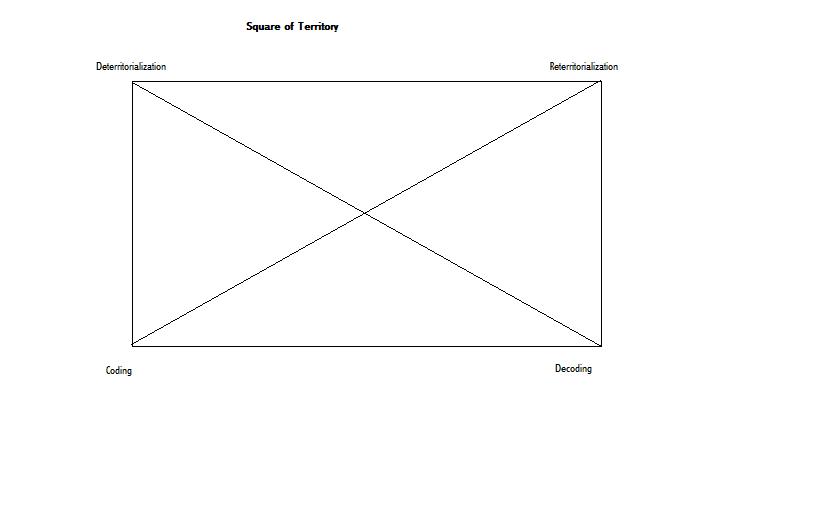
Reterritorialization connects to coding and deterritorialization connects to decoding. For every deterritorialization we have a co-efficient of decoding… A breaking down of established codes. For every reterritorialization there is a process of coding (this isn’t entirely accurate for D&G as coding there pertains specifically to social systems and power). Deleuze and Guattari argue that all deterritorialization is accompanied by reterritorialization such that there isn’t an ultimate deterritorialization without the thing landing back somewhere. The trap that must be avoided lies in believing that deterritorialization and decoding are inherently emancipatory. Deterritorialization and decoding describe certain operations of transformation and change. In order to think about emancipatory transformations, we would have to map this territorial square onto the semiotic of reactive and active forces, affirmation and negation, that Deleuze develops in Nietzsche & Philosophy producing a three dimensional cube with a variety of different possible relations, that would look something like this (click to enlarge):

This diagram is quite complex and I wont provide a commentary here. However, those who have argued that for Deleuze the “political solution” (already a bad way of speaking anyway, given the local nature of assemblages and their relationality) is deterritorialization are grossly misrepresenting his position. Deterritorialization is tremendously important and it is clear that any emancipatory prospect with respect to a specific assemblage will involve deterritorialization and decoding, but this is only a necessary condition not the entire story. I wonder if this might not be a useful way of talking about rhetoric. 1:46 PM
Subscribe to:
Posts (Atom)