Tuesday, October 23, 2007

You have perhaps caused as much destruction of life by your abstinence

Comrades .... Of late I have acquired a deep interest in the works of the Late Bengali Revolutionary Aurobindo Ghosh who was the leader of the Armed Movement in Bengal in the early part of the 20 the Century. It was not overnight, I have been reading some of his works sporadically during the last one year but it is only of late that I have started making a concentrated effort at trying to understand his works more comprehensively. I feel there is a need that some of his works and commentary needs to be discussed, I think I smell a new blog cooking....will keep you all updated....Below I present an extremely relevant quote that I came across recently. Aurobindo Ghosh on Violence
War and destruction are not only a universal principleof our life here in its purely material aspects, but alsoof our mental and moral existence. It is self evident that in the actual life of man intellectual, social, political, moral, we can make no real step forward without a struggle, a battle between what exists and lives and what seeks to exist and live and between all that stands behind either, It is impossible, at least as men and things are to, to advance, to grow, to fulfill and still to observe really and utterly that principle of harmlessness which is yet placed before us as the highest and best law of conduct. We will use only soul force and never destroy by war or any even defensive employment of physical violence? Good, though until soul force is effective, the Asuric force in men and nations tramples down, breaks, slaughters, burns, pollutes, as we see it doing today, but then at its ease and unhindered, and you have perhaps caused as much destruction of life by your abstinence as others by resort to violence...It is not enough that our hands should remain clean and our souls unstained for the law of strife and destruction to die out of the world. - Sri Aurobindo Ghosh (1872 - 1950)
Posted by Abhay 10/22/2007 08:39:00 PM Monday, October 22, 2007

Monday, October 22, 2007

Acting out, reaction formation, denial, projection, displacement

THE REAL WAR ON CHILDREN: Jihadi Kids vs Metrosexual Kids from Dr. Sanity by Dr. Sanity Mark Steyn has a column that addresses the recent SCHIP controversy and the remarks of Democratic Rep. Pete Stark...
Pelosi and the Democrats go on and on blah blah blah about "the children", even as they continue to propose more and more entitlements/Ponzi schemes that will leave it to "the children" (when they are grown-up, of course) to figure out how they are going to pay for it. Steyn rightly points out the imminent societal collapses that can be expected in European countries who have been playing this game much more earnestly than in the U.S. Betsy has more on the fiscal aspect of Steyn's piece, which you should read in full.
From a wider perspective, though, what Steyn is talking about is the politicization of children; i.e., the use of children to advance a political or ideological agenda. This sort of child abuse is going on on a number of levels, both in Western culture and in Middle Eastern culture. Specifically, I want to focus on the hyper-sexualization of children in the West, and the concommitant hyper-"aggressivization" of children in the Arab/Islamic world. A recent search of the headlines will give us plenty to ponder on the sexualization being waged in the West. Consider this. And this. and this. In Norway: this Or how about this?
What does any of the above represent, except an all-out assault on the sexual identity and genitalia of today's children. Oh, don't bother to tell me this is all done with the best of intentions...quite frankly, I'm rather sick of hearing that particular line.
  • Don't these do-gooders ever consider the long-term consequences of their actions?
  • Or is it just enough for them to feel in the moment oh-so-good about what wonderful, modern, tolerant, progressive people they are?

They will conveniently forget that it was their policies and their agenda when the sexual chickens come home to roost (imagine an entire society of Brittainys and Madonnas and their male equivalents).

Meanwhile their socialist counterparts in the Middle East really have perfected a way to accomplish what the Stark Raving Mad congressman from Maine insinuated (i.e., "President Bush wants to breed a generation of sickly uninsured children in order to send them to Iraq to stagger round the Sunni Triangle, weak and spindly and emaciated and rickets-stricken, to get their heads blown off)--with one little creative modification!
When they blow their little heads off, they will be dying to blow yours off, too. These jihadi kids don't draw guns and play as a means of discharging youthful aggressive impulses on the road to civilized behavior; they shoot them for real, at real human targets and are rewarded according to how much they are able to express the uncivilized cultural hatred that motivates the adults in their society. Instead of learning civilized behavior, they learn to project their hatred onto Jews and Christians. This is a violent video "game" in real life.
Do you imagine there is not a difference between fantasy play (which teaches a child how to control impulses and tame his or her inner monsters in the safety of fantasy) and participating in real-life violence, brutality or sex (which gives tacit permission and actively encourages the child to become his or her inner monsters) ? If you are unable to distinguish the difference, then you must be a member of the so-called "reality-based" community who seem to specialize in utopian fantasies where human aggression has been magically eliminated from the species, and we all "make love, not war" in some utopian meadow of the not-too-distant future. Good luck with that.
Instead of channeling human aggression and sexuality into societally productive avenues that benefit both individuals and cultures in which they live, we are witness to the spectacle of the political left gleefully encouraging and supporting dysfunctional sexuality that reeks of entitlement, irresponsibility, and perversity. Their moral counterparts in the "religion of peace", channel it directly into hatred and religious fanatacism.
Frequent visitors to this blog might recall that I have written quite a bit about psychological defense mechanisms (and here, for example) which operate unconsciously for the most part; and that they exist in a spectrum from immature to mature. On the immature end we have psychotic denial and ordinary denial (which children engage in frequently). As they mature, ordinary denial will morph into psychological repression (a neurotic, lower level psychological defense) and with maturity, the individual may evolve into using a process of sublimation, one of the most mature defenses, to manage any inappropriate sexual or aggressive impulses.
Contrary to the usual marxist propaganda, it is not capitalism that is encourages the use of immature psychological defenses, but life itself. But, it is capitalism and the capitalist system that offer a healthy channel for the redirection of negative psychic energy into something positive for both the individual and the group at large.
Something, I might add, that marxism, socialism and all its malignant variants completely fail to do. In fact, what they encourage are the use of unhealthy defenses (acting out, reaction formation, denial, projection, displacement to name a few) which, because such defenses are suboptimal and even self-defeating in the long-run, do nothing to improve the lot of either the society at large, or the individual unlucky enough to be living in it.
Societies, like individuals, can adopt mature defenses and deal with reality; or they can deny reality and look elsewhere for the source of their problems. Many countries, like individuals, prefer to put the blame for their own failures onto an outside source, since that is safer for the self-image. In order to maintain the fiction that their problems are caused externally, a group or country or culture needs to indoctrinate children at the earliest age possible in order to make sure that their cognitive faculties are short-circuited and won't question the ideology or dogma.
A "healthy" country, like a healthy individual will utilize mature defenses to cope with their aggressive and/or sexual impulses. They are not afraid of their aggressive impulses because those impulses are reigned in by reason and not indulged in lightly. They are able to find pleasure and satisfaction in their sexual impusles, not by indiscriminantly indulging in every pleasurable urge or whim, but by harnessing that sexuality to values that promote true intimacy and happiness. Healthy societies do not encourage either sexual or aggressive (i.e. violent) acting out in their children. On the contrary, healthy societies encourge responsible sexual behavior and appropriate and realistic compromise and accommodation of others.
Sex and aggression are very closely connected. According to Freudian theory, all behavior can be thought of as motivated by a desire to feel pleasure. That motivation is organized and directed by two instincts: sexuality (Eros), and aggression (Thanatos). Freudian psychology in its earliest incarnations was almost obsesively preoccupied with sex. This is because Freud himself lived in a puritanical Victorian-era society and was reacting against the extreme prudishness of the age. The psychological symptoms Freud saw in his practice and described so brilliantly were to be expected in a society that ruthlessly repressed sex.
One does not need to wonder what kind of symptoms are to be expected in a society that, instead of repressing it, glorifies it and indoctrinates its children into sexual pleasures without concomitantly teaching them about personal responsibility or that there are real world consequences to one's behavior (something that can only be learned with maturity).
In my profession, we have been dealing with these "counterFreudian" symptoms since the "sexual revolution" peaked in the middle of the last century. Nothing like a little Utopian Marxism-gone-berserk to really alienate people from themselves, destroy interpersonal relationships and produce a society that joyfully celebrates sex without personal intimacy for the glorification of the state.
Here in the West, we have glorified one instinct (sex) while ruthlessly suppressing the other (aggression)
Meanwhile, children on the other side of the world are indoctinated into violence without benefit of conscience, as their religion and culture ruthless suppress sex and glorify aggression and violence in the name of god. Jihadi Kids vs Metrosexual Kids. Both are very similar psychic processes that pervert two natural human instincts and channel them them into mindless human actions, unconnected with human reason or compassion. Both have become deliberately politicized and foisted on children in order to advance a utopian ideology and agenda. Now that is a real war on children.

Sunday, October 21, 2007

Written text allows for certain possibilities that oral traditions or the internet do not

larvalsubjects Says: October 17, 2007 at 4:48 pm I do, of course, agree that environment has a formative influence on us. This is what all my talk of individuation is about:
However, I would disagree that there are transcendent, transhistorical, non-situated values through which we might posit values to evaluate situations. Values must themselves be individuated or emerge out of the structure of situations. The person arguing that there is something intrinsically negative about immodest dress has a pretty tall mountain to climb: think of the Greeks, Romans, tribes that wear nothing more than a loin cloth.
It is difficult to see how the case can be made that such things have an intrinsically negative psychological or detrimental impact. Rather, just as written text allows for certain possibilities that oral traditions or the internet do not, while also closing off other formations, so too with modes of dress and forms of life. Simply going on the basis of my own readings of Scripture, I find the obsession of many Christians with issues surrounding sex to be bizarre. The Old Testament seems more worried about questions of food and hospitality than sex. The New Testament seems more concerned with questions of how we ought to relate to our neighbor and whether we should pray in public.

Thursday, October 18, 2007

Envy is an aspect of what Freud called the death instinct

Gagdad Bob wrote:
One of the most important but little known concepts in psychoanalysis is that of envy. It is a term of art, not to be confused with the dictionary definition. While potentially present in all people, it becomes much more problematic when aggravated by primitive defense mechanisms such as splitting and projective identification. It is one of the most important "mind parasites" discussed in my book, One Cosmos Under God.
According to Webster's, envy is defined as "malice," and a "painful or resentful awareness of an advantage enjoyed by another, joined with a desire to possess the same advantage." The psychoanalytic understanding of envy is that it is an unconscious fantasy aimed at attacking, damaging, or destroying what is good, because of the intolerable feeling that one does not possess and control the object of goodness. As such, it is an aspect of what Freud called the death instinct, since it ultimately involves a destructive attack on the sources of life and goodness. Particularly envious individuals cannot tolerate the pain of not possessing and controlling the "good object," so they preemptively spoil it so that they don't have to bear the pain.

Wednesday, October 10, 2007

Church attendance gives way to spiritual longing. Newspaper reading gives way to blogging

The Odyssey Years By DAVID BROOKS nytimes.com: October 9, 2007
There used to be four common life phases: childhood, adolescence, adulthood and old age. Now, there are at least six: childhood, adolescence, odyssey, adulthood, active retirement and old age. Of the new ones, the least understood is odyssey, the decade of wandering that frequently occurs between adolescence and adulthood. During this decade, 20-somethings go to school and take breaks from school. They live with friends and they live at home. They fall in and out of love. They try one career and then try another.
Their parents grow increasingly anxious. These parents understand that there’s bound to be a transition phase between student life and adult life. But when they look at their own grown children, they see the transition stretching five years, seven and beyond. The parents don’t even detect a clear sense of direction in their children’s lives. They look at them and see the things that are being delayed.
They see that people in this age bracket are delaying marriage. They’re delaying having children. They’re delaying permanent employment. People who were born before 1964 tend to define adulthood by certain accomplishments — moving away from home, becoming financially independent, getting married and starting a family...
Two of the country’s best social scientists have been trying to understand this new life phase. William Galston of the Brookings Institution has recently completed a research project for the Hewlett Foundation. Robert Wuthnow of Princeton has just published a tremendously valuable book, “After the Baby Boomers” that looks at young adulthood through the prism of religious practice.
Through their work, you can see the spirit of fluidity that now characterizes this stage. Young people grow up in tightly structured childhoods, Wuthnow observes, but then graduate into a world characterized by uncertainty, diversity, searching and tinkering. Old success recipes don’t apply, new norms have not been established and everything seems to give way to a less permanent version of itself.
Dating gives way to Facebook and hooking up. Marriage gives way to cohabitation. Church attendance gives way to spiritual longing. Newspaper reading gives way to blogging. (In 1970, 49 percent of adults in their 20s read a daily paper; now it’s at 21 percent.)
The job market is fluid. Graduating seniors don’t find corporations offering them jobs that will guide them all the way to retirement. Instead they find a vast menu of information economy options, few of which they have heard of or prepared for.
Social life is fluid. There’s been a shift in the balance of power between the genders. Thirty-six percent of female workers in their 20s now have a college degree, compared with 23 percent of male workers. Male wages have stagnated over the past decades, while female wages have risen.
This has fundamentally scrambled the courtship rituals and decreased the pressure to get married. Educated women can get many of the things they want (income, status, identity) without marriage, while they find it harder (or, if they’re working-class, next to impossible) to find a suitably accomplished mate.
The odyssey years are not about slacking off. There are intense competitive pressures as a result of the vast numbers of people chasing relatively few opportunities. Moreover, surveys show that people living through these years have highly traditional aspirations (they rate parenthood more highly than their own parents did) even as they lead improvising lives.
Rather, what we’re seeing is the creation of a new life phase, just as adolescence came into being a century ago. It’s a phase in which some social institutions flourish — knitting circles, Teach for America — while others — churches, political parties — have trouble establishing ties.
But there is every reason to think this phase will grow more pronounced in the coming years. European nations are traveling this route ahead of us, Galston notes. Europeans delay marriage even longer than we do and spend even more years shifting between the job market and higher education.
And as the new generational structure solidifies, social and economic entrepreneurs will create new rites and institutions. Someday people will look back and wonder at the vast social changes wrought by the emerging social group that saw their situations first captured by “Friends” and later by “Knocked Up.” David Brooks The Way We Live Now Share Your Comments About This Column The columnist posts about issues that shape his perspective and addresses reader feedback. Go to Columnist Page » Next Article in Opinion (7 of 17) »

Thursday, October 04, 2007

You no longer have a university, but a series of identity constituencies

Revisiting the Canon Wars By RACHEL DONADIO NYT: September 16, 2007
But when college costs run as high as $50,000 a year, it’s harder to ignore questions like “What will this major do for my career prospects?” While humanities departments thrive at elite institutions (at Yale, for example, history has long been the most popular major, with English usually beating out economics for second place), the high cost of college today exacerbates a utilitarian strain that’s always made it hard for the liberal arts to make a case for themselves in practical-minded America. According to the Department of Education, in the 2003-4 school year, only 1.6 percent of America’s 19 million undergraduates majored in English and 1.3 percent in history, compared with 20 percent in business, 16 percent in health, 9 percent in education and 6 percent in computer science.
Not all academics object to raising market questions. For Alan Wolfe, a political science professor at Boston College and the director of its Boisi Center for Religion and American Public Life, “the introduction of economic criteria into the university is a good thing.” During the canon wars of the late ’80s, he said, scholars had an “imperious” idea that “if we want to argue about the curriculum we’re free to do that.” But now, most realize “we have obligations to the students and the parents and the taxpayers.”
According to Stanley Fish, a law professor at Florida International University and an occasional New York Times columnist, the conservative critique of academia connects to an economic one. “The message the neoconservatives were putting out, that universities are hotbeds of atheism, sexual promiscuity, corrosive relativism and a host of suspect philosophies being imported from France and Germany, actually took quite strongly with the intended audience,” said Fish, who was embroiled in these debates as chairman of Duke’s theory-oriented English department from the mid-’80s to the early ’90s. “It’s easier for a state legislature to cut university funding when there is an unflattering view” of academia, he said.
But Fish thinks humanities professors bear some blame for their diminished standing. He’s at work on a new book, “Save the World on Your Own Time,” which argues that academics should teach, not proselytize. In his view, “the invasion of political agendas” into the classroom in the ’60s and ’70s was “extremely dangerous,” since it meant classrooms could become battlegrounds for political demagoguery...
For John Guillory, an English professor at New York University and the author of “Cultural Capital: The Problem of Literary Canon Formation” (1993), “The major fact that the discipline is confronting today is global English, which is a cultural corollary of economic globalization.” At the same time, postcolonial Anglophone culture is only half a century old. “I’m often impressed by this scholarship, but I’m also concerned that this new field seems to be so disconnected from the history of literature and scholarship that goes before it,” Guillory said. “I see too many scholars in the field who know very little about anything before the 20th century, and that concerns me.”
Elaine Showalter, a feminist literary scholar and a former president of the Modern Language Association, who retired from Princeton in 2003, today urges a reconsideration of some of the changes made in past decades. “This period of discovery and recovery (for example, of women writers) has been stimulating, exciting and renewing,” Showalter wrote in an e-mail message. “But now it’s time for a period of evaluation and consolidation.”
To some, another question is how to get students to read critically in the first place. “What does it profit progressives to get minority writers like Walker and Black Elk into the syllabus if many students need the Cliffs Notes to gain an articulate grasp of either?” asked Gerald Graff, an English professor at the University of Illinois at Chicago who has written on the canon wars.
The historian Tony Judt, a self-described “old leftist” and the director of the Remarque Institute at N.Y.U., which examines Europe and European-American relations, said undergraduates often arrive unprepared from high school and seeking courses “in what we might have thought of as the old-fashioned approach” — broad surveys. But many young professors aren’t interested in teaching outside their narrow specialties, nor are they generally prepared to do so. And colleges are loath to reinstate the core curriculums they abandoned in the ’60s. “Because we lack cultural self-confidence, we’ve lacked the ability to say, ‘This is a good book and should be taught, this isn’t and shouldn’t,’ ” said Judt, who was dean of the humanities at N.Y.U. in the early ’90s.
Judt also denounces the balkanization created by interdisciplinary ethnic studies programs. Multiculturalism “created lots and lots of microconstituencies, which universities didn’t have the courage to oppose,” he said. “It’s much more like a supermarket — kids can take pretty much any courses they like: Jewish kids take Jewish studies, gay students gay studies, black students African-American studies. You no longer have a university, but a series of identity constituencies all studying themselves.” 1 2 3 Rachel Donadio is a writer and editor at the Book Review. RelatedReading List: Books on the Canon Wars (September 16, 2007) Review: 'The Closing of the American Mind,' by Allan Bloom (April 5, 1987)

The salon is a thinking-machine

In 1971, Robert Darnton published an article in Past and Present that transformed the cultural history of the Enlightenment. Voltaire, d'Alembert, and their ilk, he argued, were not the whole story; the Enlightenment was not simply about brilliant men and their embrace of reason. It was also about the plodding philosophasters, the sordid scribblers, who attempted to make their living in eighteenth-century Paris. They were never vindicated, neither in their own time nor in history; the philosophes shunned them, and they were forced to subsist by writing libel and pornography. It was the anger and frustration of these men which provided much of the fury behind the Revolution. Darnton's shorthand term for this class was "Grub Street," after the eighteenth-century London street which housed a similar counterculture...
The other approach is more difficult. It would attempt to study the psychogeographical aspects of eighteenth-century Parisian cultural life. Through reconstructions of the built environment, the streets and carriages, we can study the impact of space on intellectual society. Was one salon more cramped than another? What was the significance of the eighteenth-century shift in salon structure from the immediate bedside of the woman to a more dedicated room or arrangement? Did the spaces around the salon tend to encourage conversation or isolation?
Either way, Deleuzian theory can provide some tools for looking at the problem. We may characterize the Enlightenment as a rhizome, a webwork of flows and blockages of knowledge. The salon is a thinking-machine, intertwined with an authority-machine and a legitimation-machine; it attempts to occupy some privileged site for an interruption of the flow... Posted by Greg Afinogenov at 10:13 AM 0 comments Links to this post Labels: , , , , Wednesday, May 30, 2007

Thursday, September 27, 2007

A hybrid monster that is neither adult nor child but both at the same time

All in the Family from One Cosmos by Gagdad Bob
In my opinion, we are experiencing a collapse of the covenant between mother and father as represented in the previous maternal/paternal two-party system. It is as if we are children living in a home where mother and father no longer get along, and are bickering constantly. In fact, that is probably putting it too mildly, because the current situation has gone beyond mere arguing, to the point that the masculine and feminine spheres are no longer communicating at all and are going through a very messy and acrimonious divorce. Both sides are “lawyered up” and ready to go for the throat.
I believe we may trace this divorce to the 1960s, when mother government started to become so all powerful that there was almost no role for father. Of course, this began to change in the 1980s, when father began reasserting himself because of the cultural, political and economic chaos that ensued, but by then, something else had happened. That is, the age old distinctions between mother and father and adult and child had begun to attenuate. For example, the feminist movement of the 1960s and '70s had very little to do with honoring femininity, but generally degraded and devalued it. It largely became a vehicle for the expression of female envy, giving angry and maladjusted women license to imitate the men they envied. After all, few women are less feminine than the typical NOW activist. Nor are they masculine, however. A woman cannot actually become a man, but can only become a monstrous blending of male and female.
Importantly, this is not to suggest that a woman cannot develop her masculine side or a man his feminine side. What we are talking about is a complete nullification of the differences, a kind of magical, self-imposed blindness, so that the differences are blended (because they are not acknowledged). As feminists used to say, "a woman needs a man like a fish needs a bicycle."
The other main psychological mutation that occurred beginning with the 1960s was the eradication of the differences between adult and child. Up until then, there was a clear difference between the spheres of adult and child, and everyone knew it. When I was growing up in the '60s, I had my interests and my parents had theirs, and there was very little intersection between the two -- for example, baseball with my father. But we dressed differently, listened to different kinds of music, enjoyed different activities, read different literature, liked different movies, etc.
But that has all changed now. Here again it is critical to point out that there is nothing at all wrong with an adult maintaining contact with the child part of himself. In fact, doing so is vital for creativity, spontaneity and play. Again, as in the blending of male and female, the problem arises when the differences between adult and child are obliterated, which creates a hybrid monster that is neither adult nor child but both at the same time. This affects both adults and children, for our society has become a plague of adult children and childish adults -- that is, prematurely sexualized children who, at the same time, are burdened with all kinds of inappropriate concerns about college and career, and childish adults who psychologically do not grow beyond the age of 21 or so, and never enter the realm of the truly adult. (An excellent book that discusses this phenomenon in detail is Neil Postman’s The Disappearance of Childhood.

Monday, September 24, 2007

Young people are naturally drawn to leftism, it gives one the appearance of strength, maturity, and adulthood

One Cosmos Under God Robert W. Godwin
Young people are naturally drawn to leftism, since they are at a developmental stage in which their task is to go from being a member of a primitive group -- the family of origin -- to a mature individual. This provokes a tremendous amount of anxiety (remember?), anxiety which -- because of the structure of the unconscious mind -- resonates with every past maturational stage, in which one had to pull away from "fusion" with the group (which ultimately goes all the way back to the Omnipotent Cosmic Comforter alluded to above) and become an individual. Wahhhh, Don't tase me, Dad!!!
Looking back on your own life, you can no doubt reconstruct when you were in these transitional phases between fusion and individuation. Robin spoke of one the other day, in his real-life sandbox allegory. There he was, caught between two worlds, the one of blissful primary fusion with the enveloping cosmos, vs. breaking out and becoming an individual in the decaying world of time and form. Growth can only take place by leaving the world of fusion, but it is fraught with anxiety and depression. In fact, the great psychoanalyst Melanie Klein called it the depressive position, not just because it is inherently depressing, but because one must master and assimilate the depressing loss of unity. One must contain it or be contained by it.
But many people obviously do stay behind. However, it is no picnic. It is what Klein called the paranoid-schizoid position, which has a whole array of specific (and more primitive) defense mechanisms to keep the reality of time, growth, and separateness -- and depression -- at bay. For example, one way to deny depression is through the "manic defenses," and again, we can see how leftism fits the bill, what with its manic utopian promises to end all pain and want.
The Buddha realized that attachment to our desires is the source of suffering. The left has a better idea: just make unfullfilled desire against the law.
A young adult will often embrace leftism as a form of pseudo-maturity. In other words, it gives one the appearance of strength, maturity, and adulthood, since you can be so freely aggressive, hostile, and belligerent. But this is entirely counterfeit, merely the weak man's impersonation of a strong man -- you know, "General Betray Us," and all that. Imagine General Petraeus -- who, among other inconveniences, took a bullet in the chest while training for the defense of his country -- being aggressively called a traitor by these infantile chicken doves!
Only in the unconscious, where heroes can be cowards and cowards can be heroes, where dissent is the highest form of patriotism and patriotism is the lowest form of treason. posted by Gagdad Bob at 9/23/2007 09:04:00 AM

Saturday, September 22, 2007

I do order and declare that all persons held as slaves are, and henceforward shall be, free

History and Government > U.S. Documents The Emancipation Proclamation January 1, 1863
By the president of the United States of America: A Proclamation.
Whereas on the 22d day of September, A.D. 1862, a proclamation was issued by the president of the United States, containing, among other things, the following, to wit:
“That on the 1st day of January, A.D. 1863, all persons held as slaves within any State or designated part of a State the people whereof shall then be in rebellion against the United States shall be then, thenceforward, and forever free; and the executive government of the United States, including the military and naval authority thereof, will recognize and maintain the freedom of such persons and will do not act or acts to repress such persons, or any of them, in any efforts they may make for their actual freedom.”
“That the executive will on the 1st day of January aforesaid, by proclamation, designate the States and parts of States, if any, in which the people thereof, respectively, shall then be in rebellion against the United States; and the fact that any State or the people thereof shall on that day be in good faith represented in the Congress of the United States by members chosen thereto at elections wherein a majority of the qualified voters of such States shall have participated shall, in the absence of strong countervailing testimony, be deemed conclusive evidence that such State and the people thereof are not then in rebellion against the United States.”
Now, therefore, I, Abraham Lincoln, president of the United States, by virtue of the power in me vested as Commander-in-Chief of the Army and Navy of the United States in time of actual armed rebellion against the authority and government of the United States, and as a fit and necessary war measure for suppressing said rebellion, do, on this 1st day of January, A.D. 1863, and in accordance with my purpose so to do, publicly proclaimed for the full period of one hundred days from the first day above mentioned, order and designate as the States and parts of States wherein the people thereof, respectively, are this day in rebellion against the United States the following, to wit:
Arkansas, Texas, Louisiana (except the parishes of St. Bernard, Plaquemines, Jefferson, St. John, St. Charles, St. James, Ascension, Assumption, Terrebonne, Lafourche, St. Mary, St. Martin, and Orleans, including the city of New Orleans), Mississippi, Alabama, Florida, Georgia, South Carolina, North Carolina, and Virginia (except the forty-eight counties designated as West Virginia, and also the counties of Berkeley, Accomac, Northhampton, Elizabeth City, York, Princess Anne, and Norfolk, including the cities of Norfolk and Portsmouth), and which excepted parts are for the present left precisely as if this proclamation were not issued.
And by virtue of the power and for the purpose aforesaid, I do order and declare that all persons held as slaves within said designated States and parts of States are, and henceforward shall be, free; and that the Executive Government of the United States, including the military and naval authorities thereof, will recognize and maintain the freedom of said persons.
And I hereby enjoin upon the people so declared to be free to abstain from all violence, unless in necessary self-defense; and I recommend to them that, in all cases when allowed, they labor faithfully for reasonable wages.
And I further declare and make known that such persons of suitable condition will be received into the armed service of the United States to garrison forts, positions, stations, and other places, and to man vessels of all sorts in said service.
And upon this act, sincerely believed to be an act of justice, warranted by the Constitution upon military necessity, I invoke the considerate judgment of mankind and the gracious favor of Almighty God. www.infoplease.com/ipa/A0194062.html

As if there were no women philosophers during the past 2600 years

Sexism in Philosophy By Karen Warren September 21, 2007
Sexism (and particular ways male-bias in philosophy continues) is indeed alive in Philosophy. For a wonderful, first-person account of the nature, practices and effects of sexism in philosophy on women philosophers (including women past Presidents of the American Philosophical Association), I encourage people to read the (first of its a kind) edited volume by Linda Alcoff on stories of well-known women philosophers, Singing in the Fire: Stories of Women in Philosophy (Lanham, MD: Rowman & Littlefield, 2003). See also a recent exchange on the web-based Inside Higher Education news site:
The continued problem and reality of "the absence of women in philosophy" is particularly evident in the courses taught and textbooks used in the history of philosophy. The so-called "recovery project"--a scholarly endeavor begun by a handful of women philosophers in the 1980's--continues to unearth the names and texts of several hundred women philosophers that span the traditional philosophical time periods (Ancient, Medieval, Modern and Contemporary philosophy). This project has resulted in increasing numbers of books on women philosophers in the history of Western philosophy.
Nonetheless, to my knowledge, there has not been one book/textbook that includes (in the same book) women philosophers alongside their historical men philosopher contemporaries. (This is in contrast to the exceptionally few textbooks in the history of Western philosophy that include some women philosophers, even though they remain a disproportionately low number relative to the number of men philosophers included in the same book, especially from 600 B.C.E. to 1500 A.C.E.) A book that will correct that--what I think is the first book of its kind in any language--is the book Gendering the History of Western Philosophy: Pairs of Men and Women Philosophers from the 4th Century B.C.E. to the Present, with Lead Essay, Chapter Introductions and Commentaries, ed. Karen J. Warren (Lanham, MD: Rowman & Littlefield, forthcoming Spring 2008).
The commentaries in this book are written by "commentators" who are experts on "the inclusion" of women philosophers in the history of Western philosophy; many were among those who began or contributed to "the recovery project" at its earliest stage. Their scholarship in this book and elsewhere contributes to the resolution of the male-gender bias exclusion of women in the history of "our" discipline-- an exclusion that continues, often unnoticed, by the majority of those who teach and write in the area of the history of Western philosophy.
With the publication of Gendering the History of Western Philosophy in 2008, it will no longer be scholarly acceptable or accurate to teach courses in the history of Western philosophy by using familiar but totally or largely gender-exclusive books, as if there were no women philosophers during the past 2600 years. Posted at 01:25 PM in Philosophy Rowman & Littlefield Publishers Blog Independent Books for Independent Minds

Friday, September 21, 2007

Decoding is the disruption of these social codes

The Alethetics of Rhetoric Posted by larvalsubjects under Antagonism , Assemblages , Communication , Deleuze , Heidegger , Politics , Rhetoric , Systems , Uncategorized September 21, 2007
The more the vector nature of my body is enacted, the less my body as meat appears. We experience this, for instance, in moments where we are entirely involved in what we are doing, such as when we are at the top of our game when running or involved in a sporting event or when writing. Duchamp captured this well with his famous painting “Nude Descending a Staircase”:

The body descending a staircase disappears as meat, is concealed as meat, and instead reveals or discloses itself as pure vector in motion. It is only when my vectors fail, when I break my leg while running, when I’m seen (Sartre and the look) that my body is disclosed as meat, as a foreign substance at odds with me that isn’t entirely under my control.
The case is similar with the medical body. When I grasp another person in sexual embrace, I simultaneously encounter them as meat and as vector while simultaneously encountering myself as meat and vector. Yet in the case of the medical gaze, the body is disclosed as meat; or better yet, as machine. The surgeon operating on a body does not encounter that body as person, but rather as a machine. Here the body is disclosed as being closer to a car engine, than as an other. Consequently, the body as other, the other’s body, is concealed in medical practice. It could be said, in this regard, that the first body of medical practice is the body of the autopsy.

A central element of the Heideggerian discovery (pardon the pun) was thus the discovery that beings disclose themselves under various modalities, and that in disclosing themselves they also conceal something at one and the same time. Thus, for example, if I encounter a hammer as a hammer, its material and geometric properties such as wood, iron, its shape, etc are simultaneously concealed. In encountering the hammer as a hammer, it is disclosed in its “handiness”. All of its properties come to refer to this handiness. Its spatial properties are disclosed in terms of its fitness for the job at hand. Its mass is disclosed only in terms of the job at hand, i.e., is it too heavy or light for the job? In order to encounter the hammer as a material object the handiness of the hammer needs to be made to disappear so that it might appear as a brute object composed simply of physical properties such as those described by the chemist and the physicist. That is, the hammer needs to appear under a new modality of being similar to the modality under which a rock discloses itself to the geologist.
Petraeus or Betray Us

To capture the alethics of rhetoric, we might make reference to the controversy surrounding the recent MoveOn.org ad in The New York Times. For those outside the United States, MoveOn.org is a progressive organization that has sought to promote democratic causes. In particular, they have been vocal and powerful opponents of the war in Iraq. Last week, MoveOn took out a full page ad in The New York times questioning General Petraeus’ testimony before the Senate. This ad immediately generated outrage among conservatives who have claimed that MoveOn was disrespecting the troops. The outraged immediately demanded that Democratic presidential candidates denounce the ad, and indeed, there was even a vote on the Senate floor today that would formally denounce the ad. 22 Democrats voted in favor of this motion.
Without Exception
One of the key consequences of Deleuze and Guattari’s ontology of immanence is that beings, without exception, are relational. As Deleuze and Guattari put it in A Thousand Plateaus when describing the game of Go,
Let us take a limited example and compare the war machine and the State apparatus in the context of the theory of games. let us take chess and Go, from the standpoint of the game pieces, the relations between the pieces and the space involved. Chess is a game of State, or of the court: the emperor of China played it. Chess pieces are coded; they have an internal nature and intrinsic properties from which their movements, situations, and confrontations derive. They have qualities; a knight remains a knight, a pawn a pawn, a bishop a bishop. Each is like a subject of the statement endowed with a relative power, and these relative powers combine in a subject of enunciation, that is, the chess player or the game’s form of interiority. Go pieces, in contrast, are pellets, disks, simple arithmetic units, and have only an anonymous, collective, or third-person function: ‘It’ makes a move. ‘It’ could be a man, a woman, a louse, an elephant. Go pieces are elements of a nonsubjectified machine assemblage with no intrinsic properties, only situational ones. Thus the relations are very different in the two cases. Within their milieu of interiority, chess pieces entertain biunivocal relations with one another, and with the adversary’s pieces: their functioning is structural. On the other hand, a Go piece has only a milieu of exteriority, or extrinsic relations with nebulas or constellations as bordering, encircling, shattering. All by itself, a Go piece can destroy an entire constellation synchronically; a chess piece cannot (or can do so diachronically only. (A Thousand Plateaus, 352)

Much of the history of philosophy can be read as an attempt to formulate an exception that would function as a ground or foundation halting the endless productivity of the relationality of being. Thus, the Platonic forms possess the quality of “vertical being”, standing outside the world of appearances, thereby remaining uncontaminated by the changes wrought in the being of a being by entering into a new relation with another being. Similar claims could be made regarding Descartes’ cogito and the transcendence of his God, that halts the infinite regress of grounding. If someone asks Descartes why 2 + 2 = 4 and the person persists after he gives a long mathematical explanation, Descartes can end this line of questioning by simply saying “because God willed it”.
For Deleuze and Guattari, by contrast, all beings are dynamically relational, such that their being changes when entering into new assemblages with other beings. Predicates are not intrinsic properties of beings, but are products of the relations they enter into, in much the same way that a dish can be completely transformed by simply adding an additional ingredient. When Deleuze and Guattari thus speak of deterritorialization, reterritorialization, decoding, and coding, what they are describing is shifting relations in assemblages and between assemblages that lead to transformations in the entities belonging to these assemblages and to assemblages themselves.
To deterritorialize is to take something from its native territory and situate it elsewhere. They give the example of a club. A club is a deterritorialized branch. As a branch it functions to gather sunlight to produce nutrients. When it is deterritorialized and made a club, it is reterritorialized in the human hand as a weapon. Coding refers to categories by which things are sorted and organized. For instance, I am coded as a professor. This code includes certain legal rights, as well as social duties, responsibilities, prohibitions, etc.
Decoding isn’t the activity of breaking a code to find its secret meaning as in semiotics, Freudian psychoanalysis, etc. Rather, decoding is the disruption of these social codes, the activity of taking them apart. A number of comedies are about deterritorialization and decoding. In Mr. Mom the father is laid off and his wife has to go to work for his family. He is deterritorialized from the milieu of fatherhood and reterritorialized in the milieu of the mother. There’s a scrambling of codes that takes place, as well as a general decoding (perhaps) of traditional roles generating something new. The humor lies in the reterritorialization and the way his reterritorialization in the code and territory of “mother” generates a scrambling of codes. There’s a sort of “echo-effect” between the previous code and the new emerging code that produces the humor. The two codes are superimposed over one another like two faces superimposed over one another in a photograph, creating a resonance that produces a humorous discordance. Michael Keaton’s character drives into the school parking lot from the wrong direction, displaying his ignorance of the “motherly” codes, while nonetheless having been situated within that code. We know the codes for our society pertaining to fatherhood and motherhood, such that when an entity is placed in the wrong categories, wackiness ensues.
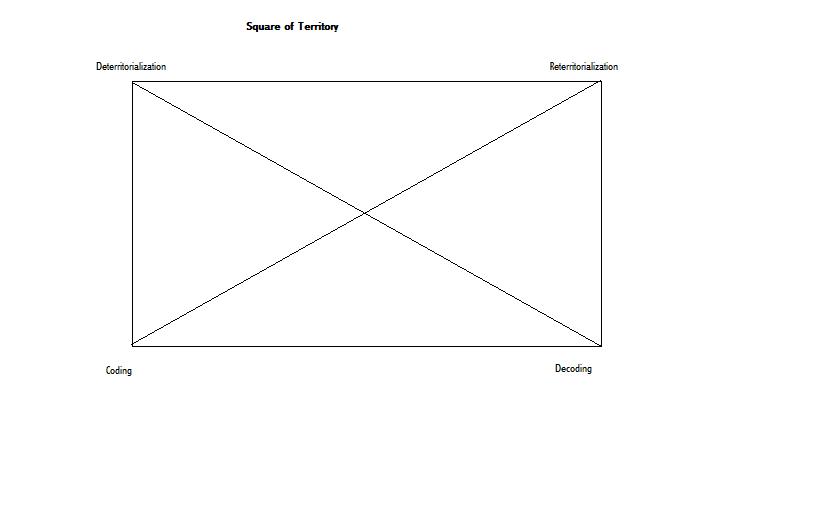
I think there’s thus a sort of four-pointed schema at work here. We can imagine a square with lines crossing from point to point and meeting in the middle, it would look like this (click to enlarge):

Reterritorialization connects to coding and deterritorialization connects to decoding. For every deterritorialization we have a co-efficient of decoding… A breaking down of established codes. For every reterritorialization there is a process of coding (this isn’t entirely accurate for D&G as coding there pertains specifically to social systems and power). Deleuze and Guattari argue that all deterritorialization is accompanied by reterritorialization such that there isn’t an ultimate deterritorialization without the thing landing back somewhere. The trap that must be avoided lies in believing that deterritorialization and decoding are inherently emancipatory. Deterritorialization and decoding describe certain operations of transformation and change. In order to think about emancipatory transformations, we would have to map this territorial square onto the semiotic of reactive and active forces, affirmation and negation, that Deleuze develops in Nietzsche & Philosophy producing a three dimensional cube with a variety of different possible relations, that would look something like this (click to enlarge):

This diagram is quite complex and I wont provide a commentary here. However, those who have argued that for Deleuze the “political solution” (already a bad way of speaking anyway, given the local nature of assemblages and their relationality) is deterritorialization are grossly misrepresenting his position. Deterritorialization is tremendously important and it is clear that any emancipatory prospect with respect to a specific assemblage will involve deterritorialization and decoding, but this is only a necessary condition not the entire story. I wonder if this might not be a useful way of talking about rhetoric. 1:46 PM

The woman is very jealous of her husband’s time because her entire life is one big wait

An und für sich “This is more a comment than a question…”
Deconstructing Simone de Beauvoir September 20th, 2007 [The following is adapted from a response paper submitted for my French Feminism seminar.] by Adam
It is widely agreed that the dominant thread of The Second Sex buys into the masculine as the norm. In the intro she says,
“man represents both the positive and the neutral, as is indicated by the common use of man to designate human beings in general; whereas woman represents only the negative, defined by limiting criteria, without reciprocity” (xxi),
and she more or less endorses that scheme throughout – the solution is for women to have the status that men have already attained. Of the two sexes, men really have attained the universal position, and women just need to be brought up to speed. It’s as though men are the real “adults,” and her often very denigrating comments about female passivity, hysteria, dependency, manipulativeness—really the entire gamut of misogynist clichés—might be read as a way of shaming her fellow women into shaping up (implicitly, as she herself has done).
But I’m reminded of something that was said at a memorial event at Northwestern after Derrida’s death – Penelope Deutscher said that Derrida was always a feminist sympathizer, but never really did a deconstructive reading on women’s texts (not sure if she mentioned it at the time, but the one exception appears to be his book on Cixous). She suggested the work of Harriet Taylor Mill as a possibility, and it seems to me that Beauvoir might have some of the same potential. That is to say, there’s a lot in this text that cuts against the “official” position of “man == universal.” Some of this can be found in the chapter “Dreams, Fears, Idols.” It starts out with an account of men’s “ontological and moral pretensions,” but it’s unclear to me exactly how seriously she’s taking the scenario she’s laying out here:
“Before him, man encounters Nature; he has some hold upon her, he endeavors to mold her to his desire. But she cannot fill his needs. Either she appears simply as a purely impersonal opposition…; or she submits passively to man’s will and permits assimilation…. In both cases he remains alone…” (139).
She seems to deduce the need for woman first of all from the unresponsiveness of Nature. In a way, this is parallel to the Genesis account where God has Adam go through all the animals looking for a “helpmeet”—but then Beauvoir also draws a contrast between the peer relations among men, which she conceives as essentially competitive and therefore exhausting. So relations with a genuine peer are too hot, relations with nature are too cold – but relations with a woman are just right.
Most of Beauvoir’s text is very hard on women, but in the rest of this chapter she really, really takes aim at men – and speaking as a member of that needy, infantile, sentimental, fearful, illogical gender, I can say that she hits her target pretty squarely. This, to me, is the “lever” for a counter-reading of The Second Sex. In relation to other men, men may be “adults,” but in relation to women, they are simpering children. The counterpoint to this for her may be that the woman becomes manipulative, etc., but Beauvoir is always at pains to say that the stereotypical woman’s behavior stems from an unsatisfactory situation—for instance, the woman is very jealous of her husband’s time because her entire life is one big wait, etc. If “man” names the neutral position of mutually “adult” relationships, then with respect to women, men paradoxically are not yet “men.” But then if you look at what she promotes as the concrete effects of women’s equality, it doesn’t look like the competitive individualistic relationships among “men” is really the goal for her—instead, there’s a different kind of mutuality, where each can be the “other.” So if the “man” is the one who must always be Subject over against the Other, then the man in genuine relationship with an emancipated woman will no longer be a “man” either.
One part to the approach I’m proposing is to read “Dreams, Fears, Idols” as a kind of “deconstruction” of the masculine ideal. What she’s doing in this chapter seems to me to be very subtle and complex—on the one hand, she’s starting out with this presumption of individualism, but under the heading of men’s “ontological and moral pretensions.” We know from previous chapters that she views, for instance, childbirth as a fundamental category—though it seems almost too obvious to explicitly say this, she knows that men don’t really “start out” alone and only later come to know women. Once she brings them into contact with women starting from the masculine fantasy of individualism, however, the other (rather pathetic) masculine fantasy of Woman undermines what men philosophically tell themselves they are. They idealize women but can’t stand the reality. They need women in order to reproduce, but they can’t bear the actual mechanics of the process—interestingly, because it reminds them too much of death: “man feels horror at having been engendered; he would fain deny his animal ties; through the fact of his birth murderous Nature has a hold upon him” (146). Menstruation is especially terrifying—among other negative effects, it supposedly “kills bees” (149). The myth of virginity allows man to indulge the fantasy of being able to own another person who would nonetheless still remain another person, but even that isn’t consistent: “virginity has this erotic attraction only if it is in alliance with youth; otherwise its mystery again becomes disturbing” (155).
This is not to say that the privileging of the masculine perspective isn’t very real and problematic in Beauvoir’s text. For instance, rear the conclusion, she says,
“The quarrel will go on as long as men and women fail to recognize each other as peers; that is to say, as long as femininity is perpetuated as such” (719).
Obviously this is one-sided, but I think that there are nonetheless grounds in her own text, even in the concluding sections, for saying that it is equally true that the problem will continue “as long as masculinity is perpetuated as such.” Despite the weight she gives to the man as normative in so many passages, nonetheless, when it really comes down to it, the masculine ideal is subject to some very real slippage. This is to be expected given the general principle elaborated in the same conclusion: “it must be repeated once more that in human society nothing is nature and that woman, like much else, is a product elaborated by civilization” (725)—and so, implicitly, is man.
One could argue that the better way to undermine the masculine ideal would’ve been to literally go through step by step and show how it’s nonsense: men act like they start out as isolated monads, but really they are always already in relation, etc. I think that what she in fact does turns out to be more interesting to me, though—this level of self-undermining complexity, is what really interests me in a text, far beyond anything like whether I “agree” with it or whether it measures up to some standard of argumentative rigor or whether all of the author’s sympathies appear to be in the right place. To put it differently, the most interesting texts to me are those that on one level seem to really want to do some particular thing—as in Beauvoir’s more or less “official” position that women need to be elevated to the (preexisting) status of men—and yet almost can’t help but do something else as well. Posted by Adam Filed in Beauvoir, Derrida, feminism

Thursday, September 20, 2007

Atheists are the most reviled people in American society

Atheism: teaching a taboo
Professor says people who do not believe in a God are shunned, but that the class topic is a vital, societal issue. Kate Jones The State Hornet Issue date: 9/19/07 Home > Features
He's a father, a husband and a writer. But he's also tackling a taboo subject at a university: atheism. "If a philosophy class isn't making you uncomfortable, it's not doing its job." said Matthew McCormick, an associate professor of philosophy. McCormick is teaching the first atheism class ever offered at Sacramento State. And the topic, he said, makes some uncomfortable, even hateful.
"Some recent polls show that atheists are the most reviled people in American society, even more than homosexuals and minority groups…That all suggests that we've got some irrational and dangerous commitments surrounding the topic of God," McCormick said.
The word atheist is defined as "someone who asserts that there is no such being as God" according to The Presumption of Atheism by Anthony Flew, an article from postiveatheism.com. The Association of Religion Data Archives at thearda.com states that nonreligious people make up for 9.26 percent of the U.S. population. McCormick takes on this controversial topic with his own no-nonsense style, high energy and motivation, in hopes that students will understand the importance of studying atheism today.
McCormick said that one of his students taking the atheism class told his friend he was in the class, and his friend just took a big step back. McCormick is not a radical preacher of atheism who goes around screaming "There is no God" trying to scare his students and convert them to atheism. McCormick proclaimed himself an atheist at age 16, but he said he's not going to try to convert students to the belief. "Conversion is not the goal," he said.
He took the initiative to write the proposal for his new atheism class, even though he says he did get "a few raised eyebrows" along the way. Philosophy Chair Thomas Pyne, a colleague and a church-goer, said "I was for it (the class)...it's certainly a live issue right now." Although McCormick is teaching a controversial subject, he still describes his department and students as being very supportive.

Saturday, September 15, 2007

Islam gives importance to intentions; clicking of photographs for pleasure is unIslamic

Deoband issues fatwa against photography The Times of India,
7 Sep 2007, 0223 hrs IST, Pervez Iqbal Siddiqui
LUCKNOW: A fatwa issued by Darul-uloom Deoband in Saharanpur district banning photography for Muslims has created a flutter in the community and beyond. The fatwa has called photographs unlawful and against Shariat. Interestingly, the Islamic seminary has made it compulsory for students to afix their photographs in admission forms. It has also not taken into account that photographs are mandatory all over the world for those applying for Haj pilgrimage and passports.
The fatwa was issued in response to a query on photography by an Assam-based NGO by four senior clerics of Darul Ifta (fatwa section) of the seminary. The clerics are Mufti Habib-ur-Rehman, Mufti Zain-Ul-Islam, Mufti Mehmood and Mufti Zafiruddin. They stated that photography, which includes taking pictures or posing for picture, was completely against Shariat. Mufti Arifuddin, a senior faculty member at the Darul-uloom Deoband (Waqf) in Saharanpur, told TOI, "Taking photographs is completely proscribed under Shariat.''
Asked about the seminary's directive to students to affix their photos in admission forms, Mufti Arif said photographs were allowed only when mandatory. "The ban applies on photography during marriages and other social functions or for commercial use,'' he said.
Asked about passports particularly for Haj pilgrimage, he said since Islam gives importance to intentions, photographs clicked for such purposes can be permitted. "But even such photographs must not be distributed or kept with oneself with the intention of showing it to others or for the heck of it,'' said Maulana Khalid Rasheed, member of the All-India Muslim Personal Law Board and Imam of Aishbagh Eidgah in Lucknow. EMail Write to Editor
Darul-uloom Deoband issues decree against photography
Muzaffarnagar (Uttar Pradesh), Sept. 8: Leading Islamic seminary Darul-uloom Deoband has said that the clicking of photographs for pleasure is unIslamic.

"If you are appearing for an exam, or going on Haj, you have to get yourself photographed. Islam gives you the rights to fulfill your necessities. So, under these conditions, Islam gives you the permission to get photographed. But, if you are clicking pictures for your pleasure and not as a necessity, it is unethical," said Azarshah Kashmiri, a Deoband official.Minority Commission officials in Uttar Pradesh's Muzaffarnagar District also agreed with the decree.
"Photography is not a right thing to do according to Islamic tenets. But, I feel there is a huge difference between the 'unethical' and the 'illegal.' If you are in need of things like a passport, an identity card or any such thing, you do require a photograph," said Israr Ahmad, the head of the local Minority Commission.
The Deoband school has a powerful influence among Muslims in South Asia, and is known for its hardline views on gender-related issues. Earlier this month, it issued a decree saying Muslim girls should not go to co-educational schools and colleges.In 2005, it said a woman allegedly raped by her father-in-law could not stay with her husband, sparking an outcry from women's groups. Copyright Dailyindia.com/ANI

Thursday, September 13, 2007

What drinking means to the people who consume or, equally tellingly, refuse to consume

Drinking Cultures Alcohol and Identity May 2005 Thomas M. Wilson
Reviews 'An ethnographic pub crawl around the world. By examining drinking habits from rural Japan to gangland Los Angeles, these essays peer deep into the collective souls of societies, revealing their hopes and anxieties. Thomas Wilson has made an important contribution to the anthropology of alcohol.' Jeffrey M. Pilcher, author of Que vivan los tamales! Food and the Making of Mexican Identity
'It offers a fascinating insight into how and why people drink in different cultures.' Hudson Cattell, Wine East
Book Description Alcohol is not only big business, it has become an essential part of social relations in so many cultures that its global importance may be outdistancing its critics. Despite grim health warnings, its consumption is at an all-time high in many parts of the developed world. Perhaps because drinking has always played a key role in identity, its uses and meanings show no signs of abating.
  • What does sake tell us about Japan or burgundy about France?
  • How does the act of consuming or indeed abstaining from alcohol tie in with self-presentation, ethnicity, class and culture?
  • How important is alcohol to feelings of belonging and notions of resistance?

Answering these intriguing questions and many more, this timely book looks at alcohol consumption across cultures and what drinking means to the people who consume or, equally tellingly, refuse to consume. From Ireland to Hong Kong, Mexico to Germany, alcohol plays a key role in a wide range of functions: religious, familial, social, even political. Drinking Cultures situates its consumption within the context of these wider cultural practices and reveals how class, ethnicity and nationalism are all expressed through this very popular commodity. Drawing on original fieldwork, contributors look at the interplay of culture and power in bars and pubs, the significance of advertising symbols, the role of drink in day-to-day rituals and much more. The result is the first sustained, cross-cultural study of the profound impact alcohol has on national identity throughout the world today. home about us contact us author guidelines agents ordering

Saturday, September 08, 2007

Absence of a frank discussion about the many dimensions of prostitution

The Oldest Trade times of india/Editorial 8 Sep 2007
Prostitution may be as old as the human race itself, but our attitude towards it borders on the infantile. At best, we hem and haw. At worst, we argue with half-informed passion. Almost always, the debate is loaded with moral overtones. The absence of a frank discussion about the many dimensions — social and economic — of prostitution merely reflects our hypocrisy. But the age-old question is in focus again, thanks to proposed amendments to the Immoral Trafficking (Prevention) Act, 1956. The set of proposals seeks to decriminalise prostitution by treating sex workers as victims, not criminals. It calls for those behind the sex trade — pimps, traffickers, brothel owners and clients — to be punished instead.
In our country, the law is ambivalent about prostitution. It is, per se, not illegal. However, it is illegal to solicit in public. A woman is free to operate independently, but cannot conduct her business in a brothel. If caught, it is she, and not the client, who is fined and put behind bars. Are the suggested changes going to make life better for our sex workers? Yes. And no. Yes, because it acknowledges that women become prostitutes either out of choice or coercion, and cannot be penalised in either case. No, because it is a half-way measure that replaces one set of ambiguities with another. It penalises clients and agents on whom sex workers depend for a livelihood. It still outlaws brothels. It does not recognise prostitution as a legitimate means of employment. Decriminalisation is of no use if not backed by affirmative measures.
For instance, in countries where prostitution is regulated — such as Holland — sex workers undergo mandatory, regular health checks. This is crucial in the prevention of HIV and other sexually transmitted diseases. They also have access to legal recourse if abused. No such provisions are being proposed here. There is no denying that a large number of those who are part of the industry — especially minors — are trafficked by force or false promise. But these issues fall within the pale of laws that guarantee human rights and must not be confused with those regulating the sex trade. Organised sex trade is a reality. It is a result of real compulsions. We must first acknowledge, then address the complexities of the issue. And, perhaps think seriously of legitimising the trade.

Friday, September 07, 2007

From a servant model to a service provider model

Design for Servants The situation will not change until any of these four things happens:
  • People realize that their domestic servants are human beings, and stop expecting them to do stuff that they wouldn’t do themselves. Ha ha ha. Good luck trying to change the attitude of three hundred million people.
  • The government or industry associations step in and set minimum usability standards. Ha ha ha. Good luck trying to enforce the standards.
  • Domestic help moves from a servant model to a service provider model, where servants are professionals who are hired and paid well by the hour. Ha ha ha. Good luck trying to set up a professional and premium maid service in India when there are half a billion Biharis, Bangladeshis, and Nepalians who’ll happily work for peanuts.
  • More people start doing their own housework and start relying less on domestic help, and so start demanding better designed household appliances. This, I am actually optimistic about. Domestic help can be a value-destroyer in many cases: supervising servants takes up time, which you might as well use to do the work yourself. If there’s no grandmother/ jobless wife around to supervise the servant, the cost-benefit changes (which is why I’ve sacked my cook). Society, Business August 22nd, 2007 by Aadisht

Thursday, September 06, 2007

70 percent of black children are born out of wedlock

Destruction in black America is self-inflicted
By Jeff Jacoby, Globe Columnist September 5, 2007
Daniel Patrick Moynihan famously warned 40 years ago that the collapse of black family life would mean rising chaos and crime in the black community. Today, as many as 70 percent of black children are born out of wedlock and 60 percent are raised in fatherless households. And as reams of research confirm, children raised without married parents and intact, stable families are more likely to engage in antisocial behavior.
High rates of black violent crime are a national tragedy, but it is the law-abiding black majority that suffers from them most. "There is nothing more painful to me at this stage in my life," Jesse Jackson said in 1993, "than to walk down the street and hear footsteps . . . then turn around and see somebody white and feel relieved."
It isn't an insoluble problem. Americans overcame white racism; they can overcome black crime. But the first step, as always, is to face the facts. Jeff Jacoby's e-mail address is jacoby@globe.com.

Tuesday, September 04, 2007

Males that fall under the feminine side and women that fall under the masculine side

Not only was Lacan well-known for working with homosexuals (when the IPA prohibited this practice), but Lacan is pretty clear in arguing that there’s no such thing as a “normal” sexuality. Somehow this line of argumentation seems premised on the thesis that there is a sexual relationship.
I have to confess that I have a number of reservations about Lacan’s account of sexuation. I can understand the graphs themselves well enough. For me the problem is how he gets there. Lacan is fairly clear in arguing that sexuation and biological sex are distinct, such that we can have males that fall under the feminine side of the graph and women that fall under the masculine side of the graph. Yet if this is the case, then why refer to it as sexuation at all? Why not rather refer to it as a particular structure of desire? Moreover, at a certain point it seems as if discussions of sexuation fall back on the empirical, conflating the phallus, which is a signifier, with the penis and then allowing all sorts of contingent events to do the work of explanation, i.e., the same things that caused Freud trouble by virtue of relying on contingent experiences of being told that it would be “cut off”, etc.
Despite the work of Ragland, Sollers, and Verhaeghe, I just haven’t seen a convincing discussion of sexuation in the secondary lit to day. When I read seminars 14 - 21 where Lacan developed his account, his discussions strike me very much as a work that is underway and that hasn’t yet been pinned down. Somehow, whether by accidents of publication history (the release of seminar 20), or other factors, it seems that Lacan’s very provisional claims on these issues have solidified into dogma.

Biological-centeredness of the study of kinship in Anthropology and elsewhere

Dr. Sinthome, would you then say that from D&G’s criticism of the family as Ur-narrative, that the ethnographic diversity of kinship relations* should compell us to consider NOT that there must be multiple ways of treating pathology, but that there are multiple ways (perhaps even contradictory) of thinking pathologically? I mean that the typical recourse to this sort of diversity, in a more general sense, would be that we must adopt different approaches to what is essentially the same problem, rather than step back from and critiquing our very interest in maintaining a universal concept of pathology.
*The most interesting book I’ve come across in this field is David Schneider’s “Critique of the Study of Kinship.” It’s from the ’80s, and simply put undermines the biological-centeredness of the study of kinship in Anthropology and elsewhere. What’s interesting about it is that it illuminates how our very concept of kinship in the West, as an intellectual category for study as well as casual-personal, arises from our own, as he puts it, ethno-epistemology. In our case, biology and quasi-biology are the determinants in how we determine and maintain kinship relations. He also rails against the notion of fictive kin as practically contradictory; fictive kin ARE real kin, because we treat them as such. All that said, he brings attention to differing ways that strong kinship-ties are maintained, though traditional kinship categories confuse or obsfucate. Ultimately he challenges the anthropological world to either do away with the notion of kinship, or figure out a way to assess it that does not privilege, much less assume, biological relatedness as a factor. A professor who used to teach at my school would eventually make a gesture towards such a system.

Thursday, August 30, 2007

Television in rural areas have had an effect on latrine building and fan usage

Kyunki, there’s a world out there Mahima Kaul
Home > Edits & Columns > indian express: Thursday, August 30, 2007
It may not be fashionable to say it, but the Hindi soap operas — Kyunki Saas Bhi Kabhi Bahu Thi, for instance — actually might be doing us some good. Now if you are like me and flip through channels, hear overly dramatic music and change — don’t. Cable TV might be succeeding where government policy didn’t. Changing the way Indian women see their world.
How exactly does that happen? First off, this isn’t new. Back in the days when the public service broadcaster — Doordarshan (DD) — was launched, one of the guiding thoughts behind it was that the media can actually be used as a tool for development. It’s a simple premise. The visual image leaves a lasting imprint in our minds. And especially for those who cannot read, television is an effective tool for communication. Wilbur Schramm, author of Mass Media and National Development, was the proponent of this — what we now term ‘development communication’. Instead of the government forcing changes in lifestyle, the population would become aware of a need that was not satisfied by their present behaviour. And then they would borrow behaviour that would come closer to meeting those needs. And so based on soaps in Latin America, Hum Log was the first Indian soap to try out this concept, with a good measure of success.
Post-liberalisation, TV channels have been flourishing. Some 112 million households in India own a television. Of those, 61 per cent have cable or satellite service, according to the National Readership Studies Council, 2006. And the casual observer may think that the role of educating through entertainment has been relegated to DD alone. To its credit, DD is living up to its mandate. Health shows like Kalyani, and their positive effects on rural populations, have been documented by external agencies. And now, it appears, cable TV is not too far behind.
A new study by Robert Jensen of Brown University and Emily Oster of the University of Chicago has revealed that cable TV has had a distinctively helpful effect on women in rural India. Among their findings, conducted over a three-year period in five states (Bihar, Goa, Haryana, Tamil Nadu and Delhi), is that gender attitudes have been positively affected. Women don’t think their husband beating them is as acceptable now, son preference has gone down, female school enrolment has gone up, and birth spacing has increased. Now, there may be other factors contributing to these changes, no doubt, but one thing is for certain. Soap operas are changing the way women see their role in society and in families, and TV has a part to play in it. And changing expectations is the first step to changing reality.
Examples. When Tulsi (of Kyunki Saas Bhi Kabhi Bahu Thi) finds out her son raped a woman, she sides with the victim. In the end, she shoots her son. It may be a tad dramatic (we are talking about a soap opera, after all), but she stands up for what is right. In Saloni Ka Safar, a girl’s complexion is symbolic of the Indian bias against dark skin.
You are allowed to raise your eyebrow at this point. Really, you say, are those overdressed women in the prime-time Hindi soap opera world are changing rural India? Yes. And you know why? Because, for the majority of the country, television is the window to the world. And while the city folk may want to ape the lavish lifestyles of their on-screen heroes — some people partly blame the big fat Indian wedding phenomenon on these serials — rural women admire their independence.
Think about it. At their basest levels, studies have shown that exposure to television in rural areas have had an effect on latrine building and fan usage. And even more amazing is a mother welcoming a girl child because she learnt on television that she too can grow up to be a powerful, independent woman. And that education is key, so she sends her daughter to school with her brothers.
But what is it about chiffon-clad city women in particular that appeals? Because underneath the make-up and diamonds, the problems are common. Rich yes, but the women of Indian soaps are deeply traditional. Some work, but many are full-time homemakers. The problems — inner wheelings and dealings of joint families — strike a chord. They go to the temple, hold havans, they even observe Karva Chauth. And millions all over the country cheer them on as they fight for a place of respect within the family.
That’s just it. A click of a button and they take a walk around the world to ease their troubled minds.